
Zi Wei Dou Shu star brightness describes a star’s traditional status in a particular chart position. Labels such as Miao (廟), Wang (旺), Ping (平), and Xian (陷) qualify how a reader interprets that star there. They do not measure light from an astronomical object, and they cannot be turned into a score for your personality or future.
The label can be easy to miss until you see an English word like “fallen.” Before drawing a conclusion, identify which star it belongs to, where that star is placed, and which reference table the chart uses. Those details give the word its context.
What Miao, Wang, Ping, and Xian mean
The following are beginner-friendly explanations of four common labels. Treat the English wording as a guide to the traditional idea, rather than a translation that every school or app uses.
- Miao (廟 or 庙): often translated as “temple,” “exalted,” or “strongly placed.” The star is traditionally considered well situated to express its characteristic qualities.
- Wang (旺): often “prosperous,” “flourishing,” or “strong.” It also describes a relatively strong placement, usually below Miao in the reference hierarchy.
- Ping (平): often “level,” “ordinary,” or “neutral.” It describes a more moderate status in the chosen scheme.
- Xian (陷): often “fallen,” “trapped,” or “weakened.” The traditional interpretation gives greater attention to difficulties or constraints in the star’s expression.
ziwei.ist’s brightness reference presents a seven-level scheme. Other labels in that scheme include De (得), Li (利), and Bu (不), sometimes written as longer phrases. Your chart’s legend should explain the exact set it uses.
Notice that the label qualifies a star in a position. It does not describe whether you are a good person, whether your work is valuable, or whether a relationship deserves to continue. Those questions require information a status label cannot supply.
Brightness is a chart convention
In this context, “brightness” is symbolic terminology. You are looking at a traditional, table-based classification, rather than an astronomical observation or an instrument reading. Mystic Atlas’s explanation makes this distinction and notes that English sources also use terms such as strength or temple status.
It helps to separate three questions:
- Which star is this? Its name identifies the symbol being discussed.
- What status does it have here? The brightness label records the chosen table’s classification for that location.
- What does the reading make of it? The interpretation brings that information into the wider chart and the question being considered.
If an explanation skips straight from the status to a claim about your life, ask for the missing steps. A label you can locate on a chart and a conclusion about a person are different kinds of information.
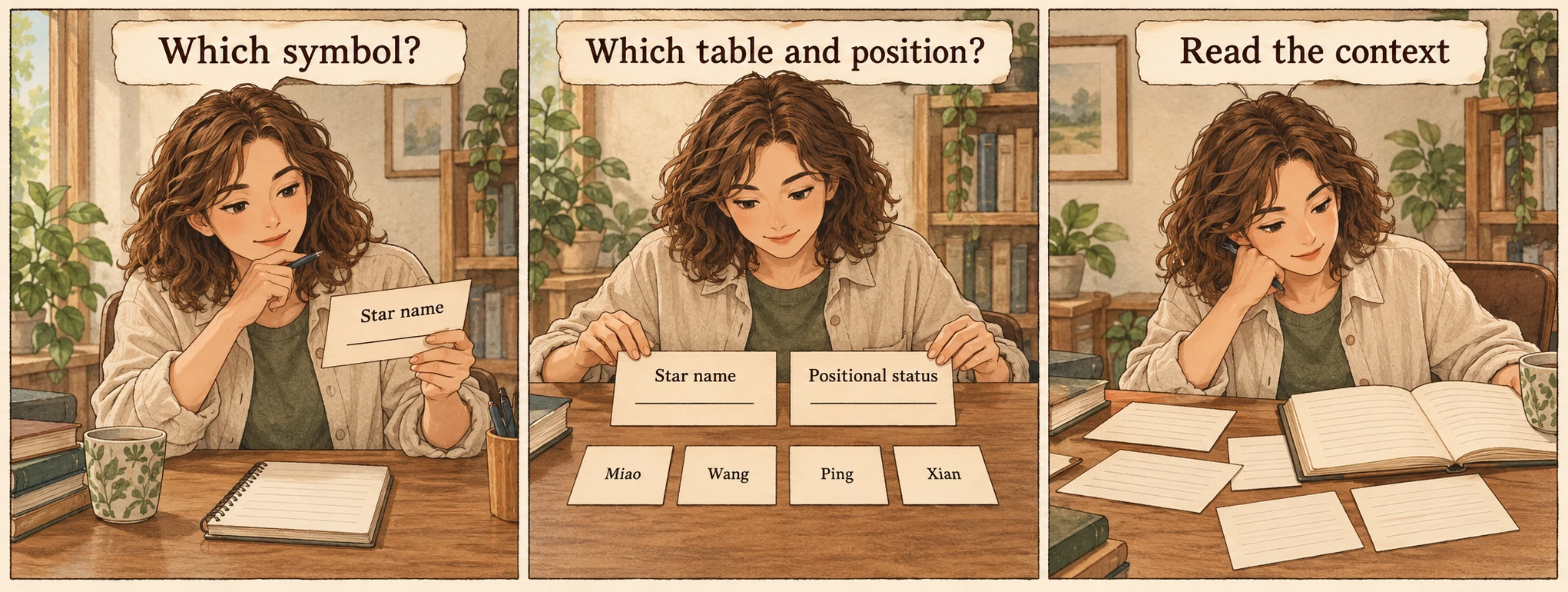
Why two brightness references can disagree
There is no single scheme you can assume every source follows. For a concrete comparison, ziwei.ist displays seven levels, while the American Feng Shui Institute’s beginning course, printed page 2-18, uses five. These references also differ in how they explain the interpretive emphasis of a rating.
The five-level course includes both 閑 and 陷, each written as “xian” in its unaccented romanization. They are separate entries. This is a good reason to keep the Chinese character beside the English or pinyin label whenever it is available. A search for “xian star meaning” can otherwise merge words that a particular reference distinguishes.
Two kinds of disagreement need different checks. If the Chinese label matches but the English wording differs, compare the translations. If the star and location match but the Chinese status differs, compare the underlying tables. Changing the English adjective will not resolve a difference between table entries.
When you cannot find the table your chart uses, note that limitation. You can still learn the vocabulary, but leave the exact rating unverified. Do not select a more flattering label from another website and quietly substitute it.
Check one star in four steps
1. Copy the complete entry
Write down the star name, the palace’s life-topic name, the Earthly Branch label if shown, and the exact brightness character or word. Include the chart provider or reference you are using. Copy first and translate afterward; this makes an error easier to trace.
You do not need to interpret every symbol in the box immediately. Circle the one status label you are checking and leave the rest visible for later.
2. Match the star with its branch position
Brightness tables commonly use star names and the twelve Earthly Branch positions as their lookup coordinates. A topic name such as Career is not enough to identify the cell in that table. Find the star’s row and the branch’s column, or the reverse if the table is transposed. The structure is visible in the iztro project’s published star reference.
Read the row and column headers out loud before copying the result. This small check helps when a compact mobile table scrolls sideways or when two pinyin names look similar. If the displayed chart and its own documented table disagree, keep a note of the mismatch and ask the provider to explain it.
3. Read the legend before comparing labels
Check whether the display uses full words, abbreviated characters, colors, or numbers. Record the legend’s wording rather than assuming that a brighter color or a larger number means a stronger status.
Numbers can be especially misleading without a key. A chart may number stars for identification and use another number for status; the American Feng Shui Institute course explains such a convention on printed page 2-25. Neither number is a personal rating.
4. Ask what the status changes in the explanation
After verifying the entry, return to the reading. Ask: “What would you interpret differently because of this label?” A useful answer should identify the star’s traditional symbolism and explain how the positional status modifies it.
Keep that explanation tentative. Write down anything you recognize from experience, along with anything that does not fit. You do not need to force your memories into agreement with the label.
Keep the rest of the chart in view
The traditional method also considers the other stars and relationships around a placement. Even the Tai Wei Rhapsody, a classical Zi Wei Dou Shu text presented with commentary by ziwei.ist, instructs readers to examine interacting conditions when a star is in Miao or Wang. Its discussion of weak positions likewise considers support. A high or low status is not the endpoint of that reasoning.
Keep brightness separate from the Four Transformations: Hua Lu, Hua Quan, Hua Ke, and Hua Ji. They belong to another interpretive layer, as Mystic Atlas explains. If both kinds of labels appear, record both. Do not replace one with the other or invent a formula that adds them into a total.
The same care applies when a reading discusses a decade or year. Note which time layer the explanation refers to, so you can follow its reasoning without accidentally combining unrelated labels.
A useful question for your YUVA reading
Keep this short note beside your reading:
- Star and palace I am asking about:
- Branch and exact status label, if shown:
- Chart source or legend:
- Sentence in the reading I want explained:
Then ask: “How does this star’s status affect the interpretation, and which other chart details are you considering?” You are asking for the reasoning behind the description, rather than a better-sounding grade.
YUVA’s Zi Wei Dou Shu guide introduces the system. The YUVA birth chart overview explains Chart, Reading, and Ask, including follow-up conversations grounded in your own Chart or Reading. You can explore YUVA with a specific question ready. These experiences are for reflection and entertainment; a chart label should not determine a major life decision.
Common questions
Does Xian mean a bad life?
No. It is a traditional classification attached to a particular star’s position. It cannot establish the quality or outcome of your life.
Does Miao guarantee success?
No. Even within traditional interpretation, readers consider more than the brightness label. Actual outcomes also depend on circumstances and choices outside the chart.
What if no brightness label is displayed?
Check the display options and legend before assuming anything. An omitted label is not a zero score. If the provider does not document it, leave it unspecified in your notes.