
The 14 major stars of Zi Wei Dou Shu are Zi Wei, Tian Ji, Tai Yang, Wu Qu, Tian Tong, Lian Zhen, Tian Fu, Tai Yin, Tan Lang, Ju Men, Tian Xiang, Tian Liang, Qi Sha, and Po Jun. Their Chinese names are the most reliable way to match a label on your chart with an English reference.
Each star has a range of traditional associations. To use this list, find the exact name first, then keep its palace and neighboring labels in view. A keyword such as leadership or change is a starting point for understanding the reading. These traditional associations cannot establish someone’s character or predict a life event.
The 14 major stars at a glance
This index uses common English renderings alongside pinyin and traditional Chinese characters. Charts may use simplified characters, such as 天机 for 天機. Translations and emphasis differ across sources. The names and associations below draw on Kaucim’s major-star reference, Sheng Pin Kai’s star guide, and AstroEW’s reference library. The last column offers questions to help you keep the interpretation specific.
| Star name | English rendering and traditional associations | Context to add before interpreting |
|---|---|---|
| Zi Wei 紫微 | Purple Star or Emperor. Central authority, leadership, dignity, and responsibility. | Which palace contains it? Ask what the reading means by authority in that life area, and which other stars contribute to the explanation. |
| Tian Ji 天機 | Heavenly Mechanism or Strategist. Planning, adaptation, movement, and an active mind. | Look for the exact transformation or companion star being discussed. Keep thoughtful adjustment and unproductive indecision as separate possibilities to examine. |
| Tai Yang 太陽 | Sun. Visibility, contribution, outward effort, and generosity. | Record the palace and brightness label. Ask how the reader connects visibility to this topic instead of assuming every Sun description concerns public fame. |
| Wu Qu 武曲 | Military Song or Martial Star. Discipline, decisive action, practical management, and financial themes. | Identify the life area under discussion. A financial association in the star’s vocabulary does not by itself explain your income, assets, or career. |
| Tian Tong 天同 | Fortune Star. Comfort, enjoyment, receptivity, and a preference for ease. | Note its companion stars before settling on an interpretation. Ask whether the reading is discussing rest, cooperation, or avoidance, and why. |
| Lian Zhen 廉貞 | Integrity Star. Principle, boundaries, intensity, and attraction are recurring themes. | Check which part of this broad vocabulary the reader is using. Ask for the chart context supporting it rather than treating integrity as a moral score. |
| Tian Fu 天府 | Heavenly Treasury. Preservation, reserves, administration, and stability. | Identify what is being managed in the palace’s topic. Keep the symbolism of storing resources separate from claims about actual wealth. |
| Tai Yin 太陰 | Moon. Reflection, care, quieter forms of influence, and accumulation. | Keep its brightness and palace with the name. When an explanation mentions inwardness, ask which situation it describes rather than adopting it as a fixed identity. |
| Tan Lang 貪狼 | Greedy Wolf. Desire, sociability, versatility, and appetite for experience. | Read the traditional name as an identifier. Ask which chart factors support the explanation; the English word greedy cannot establish someone’s character. |
| Ju Men 巨門 | Giant Gate. Speech, questioning, scrutiny, and potential disagreement. | Ask whether the interpretation concerns explaining, investigating, or arguing. A broad association with language needs a particular palace and surrounding context. |
| Tian Xiang 天相 | Minister. Mediation, fairness, service, and coordination. | Look at the role described in the reading. Supporting a group, negotiating a disagreement, and seeking approval are different ideas that need separate explanation. |
| Tian Liang 天梁 | Heavenly Pillar or Guardian. Protection, guidance, experience, and principle. | Ask how the protective theme relates to the palace. Distinguish an invitation to reflect on responsibility from a claim about an inevitable role. |
| Qi Sha 七殺 | Seven Killings. Resolve, independence, pressure, and direct action. | The dramatic name needs historical and interpretive context. Record the other chart factors; the label gives no basis for concluding someone is dangerous. |
| Po Jun 破軍 | Army Breaker. Disruption, change, dismantling, and rebuilding. | Ask what is changing in the interpretation and what supports that conclusion. Avoid turning the word change into a prediction of a specific loss or event. |
You may find quite different English nicknames for the same star. Comparing the Chinese characters is more dependable than trying to reconcile two nicknames. This guide keeps the pinyin names prominent for that reason.
Why two major stars can share one palace
The fourteen stars are arranged across twelve palaces according to placement rules. They do not occupy one palace each. A palace may contain two major stars, one major star, or none. Kaucim’s reference explains how this follows from the major-star arrangement.
The stars belong to two placement series. Zi Wei heads a group of six; Tian Fu heads a group of eight. The other stars in each group follow fixed relationships within that layout. Wudang’s star guide explains the two series and why recurring combinations matter.
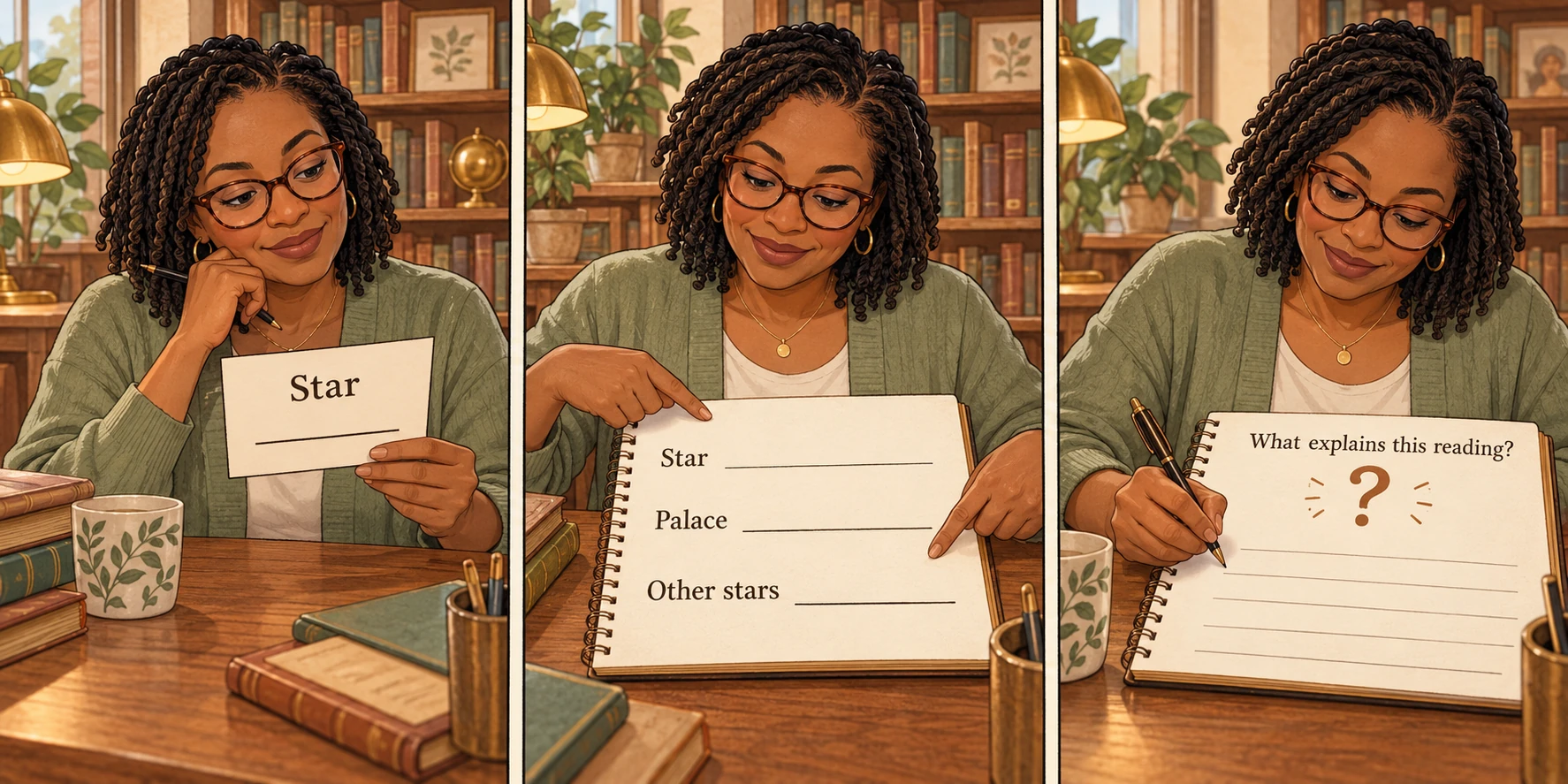
For a beginner, the practical consequence is simple: write down both names when two share a palace. Reading only the name that sounds familiar leaves out part of the configuration. When no major star appears, check the chart’s explanation of an empty palace and its relationship to the opposite palace. Other kinds of stars may still be present.
A short method for using this reference
Start with one palace
Choose the palace you are trying to understand and copy its name. If the reading concerns work, keep your notes focused on what it says about that topic. Searching fourteen broad descriptions at once makes it easy to gather statements that sound plausible without understanding where they came from.
Record all the major stars there
Use the index to identify the names. Put a question mark beside an unfamiliar label rather than guessing whether it is a major star. A chart includes other information, and every label does not belong to this list.
Add the modifiers you can identify
Note any brightness label, transformation, and auxiliary stars discussed in the reading. Brightness is a traditional chart classification associated with a star’s position. It is not a measurement of how brightly an object appeared in the sky at your birth. The Four Transformations add another interpretive layer. Wudang describes these contextual factors.
Keep the explanation and your experience separate
Write one sentence summarizing what the reading says. Then write one real observation that supports it, contradicts it, or leaves you uncertain. For example, you can examine how you make decisions without claiming that a chart caused your habits. You are allowed to leave a description unresolved.
A reusable note has five fields: palace, major star names, additional labels, interpretation offered, and question to investigate. If you are viewing a decade or annual layer, include that selection too. This keeps a later comparison tied to the same information.
Common questions about major stars
Is Zi Wei always my main star?
Zi Wei names the system and is one of its fourteen major stars. Its presence somewhere in a chart does not make its description a complete profile of the chart’s owner. If a reading calls something your main star, check how that reading defines the term.
Are Wen Chang and Wen Qu missing from the list?
They belong to the wider set of auxiliary stars, rather than the fourteen major stars. They can still matter in a reading. Major is a category within the system, not a reason to ignore every other label. The American Feng Shui Institute’s teaching material lists Wen Chang and Wen Qu separately from the fourteen majors.
Are Tai Yang and Tai Yin my Western Sun and Moon signs?
No. Their names mean Sun and Moon, but Zi Wei Dou Shu uses its own symbolic chart placements. Do not transfer Western zodiac sign descriptions onto these names. YUVA’s Zi Wei Dou Shu introduction explains the distinction between the systems.
From the star list to a YUVA reading
YUVA provides birth-chart readings based on Zi Wei Dou Shu. Use the YUVA Birth Chart overview to understand how the product uses that tradition, then bring the exact star name and palace to the reading you are exploring.
The most useful outcome of this reference is a clearer question. You should be able to identify the label and ask how it fits its surroundings.