What does a 10-year luck cycle in Zi Wei Dou Shu actually mean? In the traditional system, Da Xian (大限) is a decade-scale interpretive layer laid over your original birth chart. Liu Nian (流年) adds an annual lens. They answer different questions: what is emphasized over a longer stage of life, and what deserves attention in a particular year?
Neither layer replaces the natal chart, and neither turns a symbolic framework into a guarantee about your next job, relationship, or bank balance. The useful skill is keeping those layers separate while you read them together.
First, separate the three layers
| Layer | Chinese term | What it helps you inspect | What it cannot establish alone |
|---|---|---|---|
| Birth chart | 本命盘 (Ben Ming) | The original placement of palaces, stars and natal transformations. | An exact event date or an inevitable outcome. |
| Decade cycle | 大限 (Da Xian) | Which palace network and themes become foregrounded across a traditional ten-year stage. | That every year of the decade will feel the same. |
| Annual layer | 流年 (Liu Nian) | What the yearly palace and transformation pattern bring into focus within the natal and decade context. | That a single auspicious or difficult marker overrides the rest of the chart. |
Some schools additionally read Xiao Xian (小限, minor limits), lunar months, days, and hours. These methods are not interchangeable. Use the terms and boundary rules of the actual system you are reading instead of mixing outputs from different methods.
How does a Da Xian move through a Zi Wei chart?
The natal chart remains fixed. A traditional decade cycle successively emphasizes different palaces, typically using the chart’s Five-Element Bureau to establish its starting age and birth-chart conventions to determine the progression direction. Many schools also read decade-level transformations. Exact age ranges, boundary counting, and directional conventions should be checked against the chart calculator you use (see iztro’s educational explanation of timing cycles); a generic list of calendar decades cannot replace a personal calculation.
It helps to imagine a transparent overlay moving across a map. The roads (your natal chart) do not change; the overlay asks which part of the map you are studying for that stage. When you move to an annual layer, you add a smaller lens inside that stage.
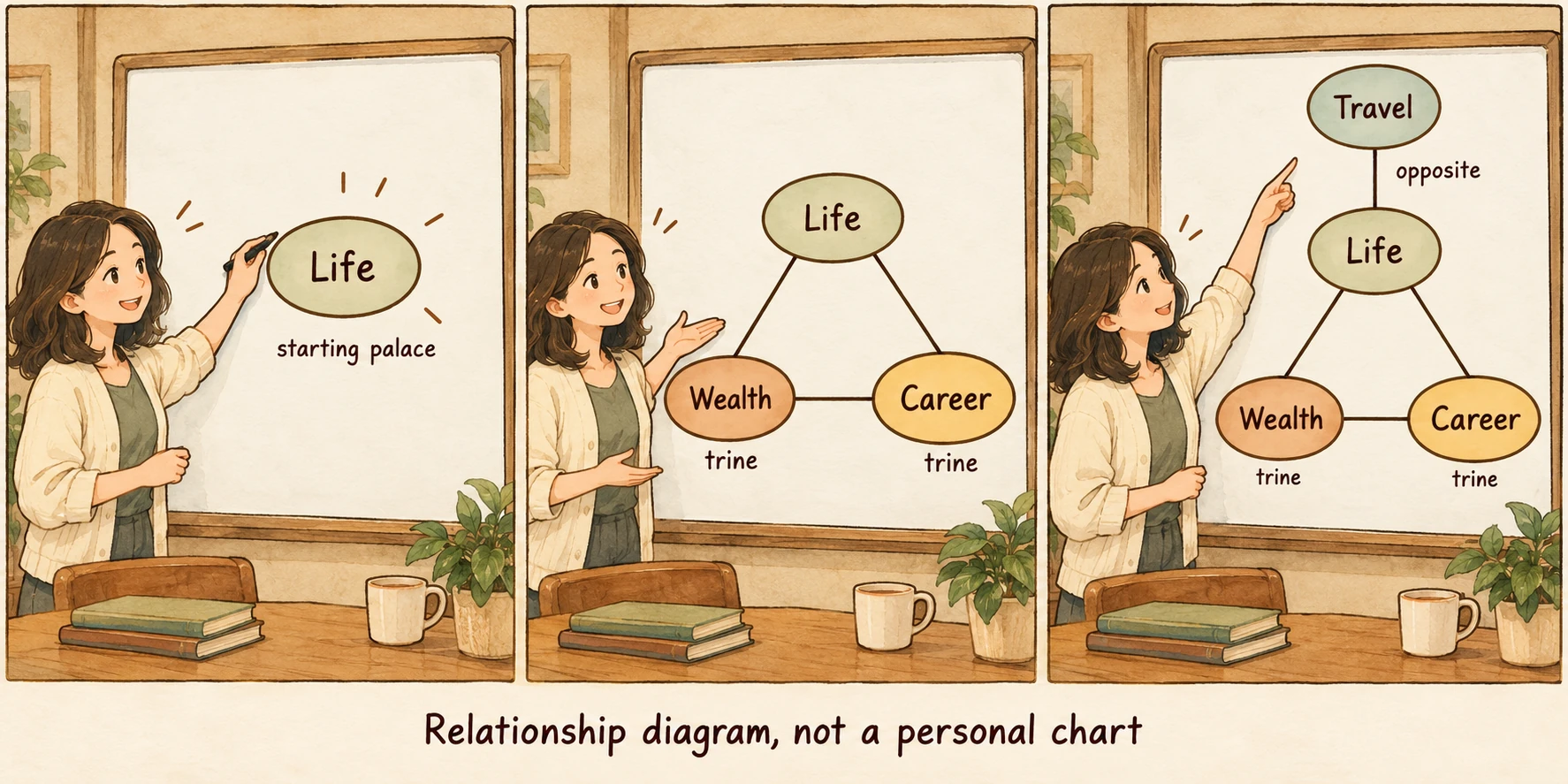
One hypothetical work question, read three ways
This example is an illustration, not a computed person’s chart. Imagine someone asking, “Should I switch careers this year?” We will not invent their birth data or star positions.
- Natal question: In the person’s actual chart, examine the Career Palace (官禄宫) alongside the Life and Wealth Palaces in its trine and the Spouse Palace opposite. What kinds of responsibility, earning patterns and commitments are described by those positions and their real stars?
- Decade question: Suppose the calculator shows a decade emphasizing work or public contribution. Read the decade’s relevant placements and transformations against the natal pattern. That indicates a subject for reflection, not an instruction to quit a job.
- Annual question: Suppose the annual layer highlights resource or relationship concerns. Does that add a current constraint or opportunity to the longer work theme? Which precise star, palace and transformation in the actual chart supports that observation?
A sensible synthesis might be: “Work direction is the long-term subject to examine, while this year’s choices may depend on resources and other commitments.” It would not be: “This chart proves you will change jobs in March.” In real life, savings, hiring conditions, family responsibilities, and your preferences still decide what to do.
Why the Four Transformations matter more than a generic “lucky year” label
Zi Wei Dou Shu readers often look for Hua Lu (化禄), Hua Quan (化权), Hua Ke (化科), and Hua Ji (化忌) across layers. They are associated with themes such as resources, authority, recognition and friction, but a label alone is not a reading.
Keep four pieces of information together: which layer, which transformation, which star, and which palace. A natal Hua Ji and an annual Hua Ji need not have the same role. It is also misleading to treat a transformation as a promise of money or a warning of catastrophe without reading its context. See our guide to the Four Transformations for the actual vocabulary.

A compact worksheet to keep your reading honest
You can use this sequence with an existing chart without pretending to be an expert in every school.
| Write down | Example of an acceptable entry |
|---|---|
| Natal baseline | “Career Palace contains [actual star names]; Wealth and Life Palaces have [actual context].” |
| Decade source | “The chart places this age in [actual Da Xian palace] under [documented calculation settings].” |
| Annual source | “The year layer marks [specific transformation] on [specific star] in [specific palace].” |
| Interpretation | “These facts suggest examining [specific theme], subject to the person’s real circumstances.” |
If you cannot fill the source cells, stop before writing a confident story. That is a useful limit, not a failed reading. Our step-by-step chart interpretation guide gives the broader reading order.
When does a Zi Wei year begin?
Don’t silently treat January 1 as the correct astrological boundary. Traditional Chinese timing practices may use different year and month boundaries, including solar-term and lunar-calendar conventions; school and software settings matter. The same is true for nominal-versus-Western age counting in decade labels. When two sources disagree about “this year’s chart,” first check the calendar boundary and calculation method rather than choosing the result you like better.
Frequently asked questions
Does the decade cycle change my birth chart?
No. The natal positions are the baseline. Da Xian changes the interpretive reference frame applied to those positions.
Is Da Xian exactly ages 20–29, 30–39, and so on?
Not necessarily. Traditional starting ages are chart-dependent, and counting conventions can differ. Read the age labels of your calculated chart.
Can a single annual Hua Ji mean a bad year?
No. It identifies one symbolic factor to interpret with its star, palace, natal context, and other timing signals.
Can I use a yearly reading to make a big financial or medical decision?
Not as a basis for professional decisions. Use the chart only as optional reflection and rely on real evidence and qualified advice.
Read the chart before the forecast
Start with YUVA Birth Chart, then use the calculator guide to understand its source fields. YUVA’s personal Reading is free after sign-in and uses 0 Credits. Do not assume every advanced timing view is available in the app just because this article explains the wider traditional method.
Zi Wei Dou Shu is an interpretive tradition, not a scientifically validated method of forecasting life events. The example above is hypothetical, not a generated personal chart.