A Zi Wei Dou Shu calculator turns your birth details into a Purple Star Astrology chart: twelve life palaces populated with stars and other chart information. The calculation is only the first step. The useful part comes next—checking that the chart is based on the right inputs, understanding what the output contains, and reading the chart as a connected structure rather than a list of isolated symbols.
Want to calculate your birth chart? Open the YUVA Birth Chart calculator →. Enter your birth date, a known local birth time (hour and minute), gender and verified birthplace. Sign in to calculate your chart and receive your free personal Reading (0 Credits). You can also inspect a fully calculated fictional example below before entering your own details.
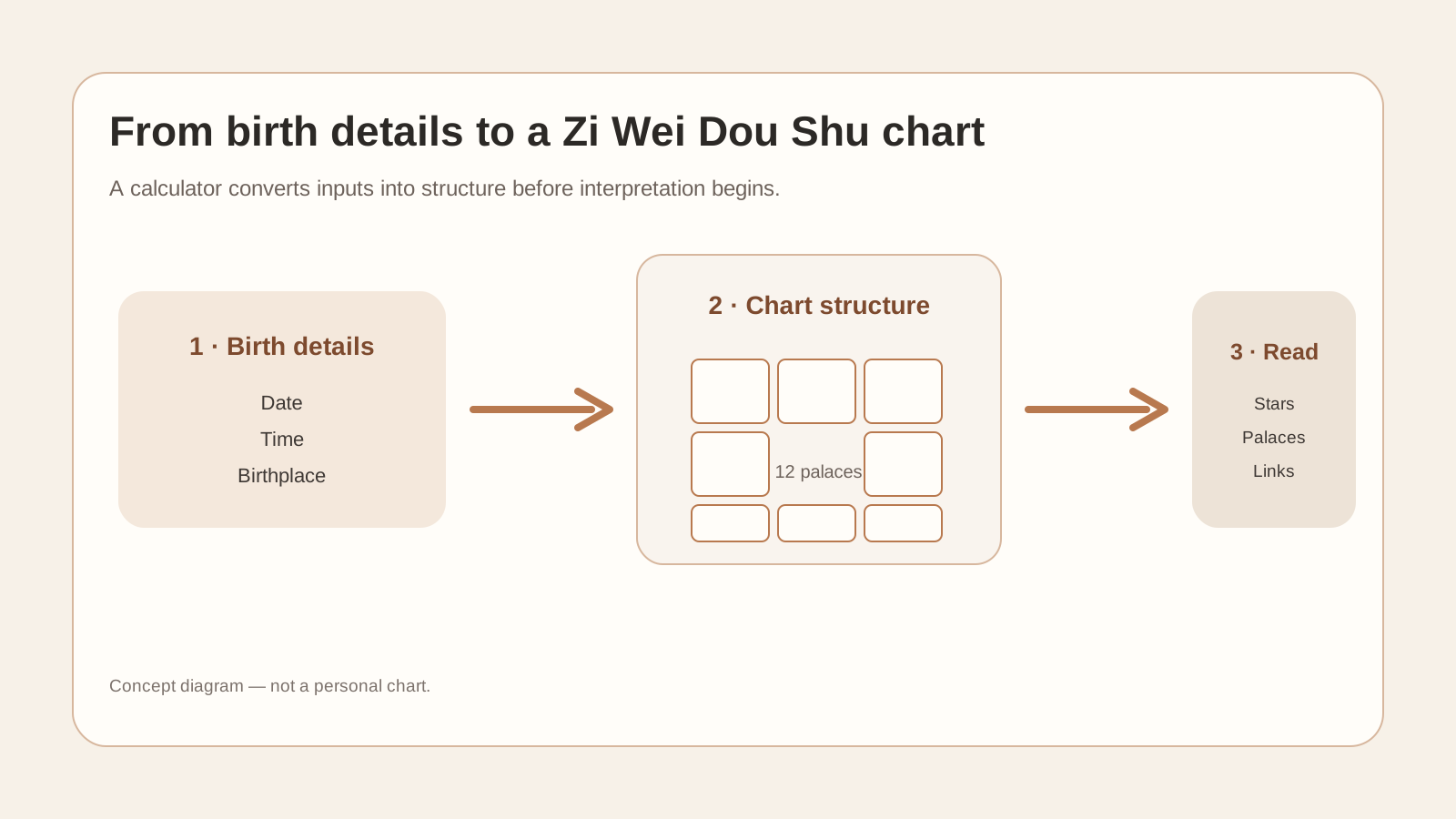
What does a Zi Wei Dou Shu calculator calculate?
Zi Wei Dou Shu, also called Purple Star Astrology, organizes a natal chart into twelve palaces. Each palace represents a life domain, while stars and other chart factors describe the symbolic patterns associated with that area.
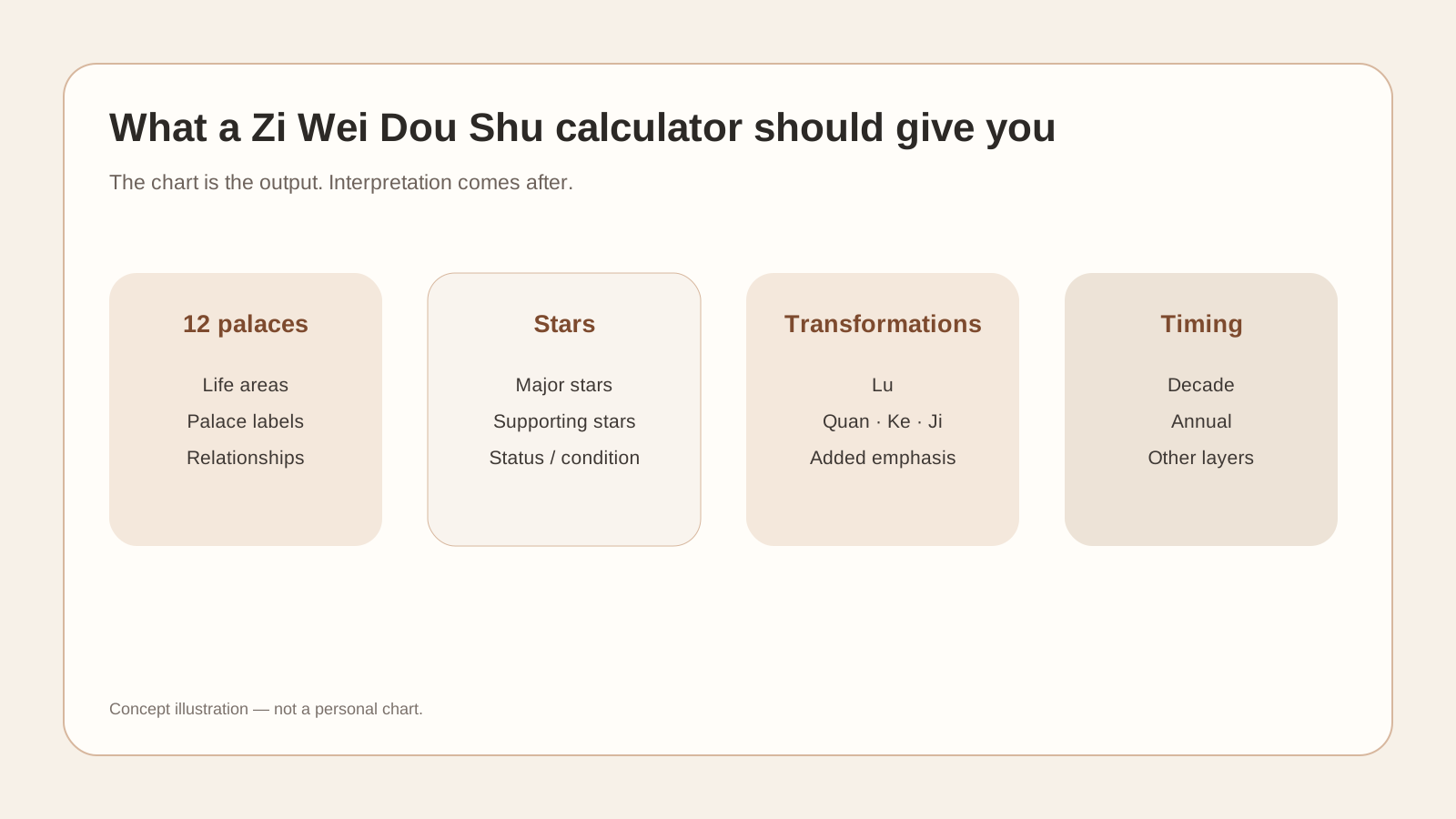
A useful calculator should do more than return one “main star.” Depending on the implementation and school, a full result may include:
- the twelve palaces and their positions;
- the Life Palace and Body Palace;
- the fourteen major stars;
- supporting or auxiliary stars;
- the Four Transformations—Lu, Quan, Ke, and Ji;
- star condition or brightness labels where the chosen system uses them;
- decade or other timing layers;
- the calendar and chart information used to construct the result.
If you are new to the system, you do not need to learn every field at once. Start by confirming the chart, then focus on one palace and its strongest relationships.
What birth information do you need?
Most Zi Wei Dou Shu calculators ask for a birth date and birth time, and many also use birthplace or time-zone information. The exact interface varies.
The most important rule is simple: enter the information you actually know. If your birth time is uncertain, do not silently convert an estimate into false precision. Time-sensitive chart placements may change when the underlying input changes.
If you do not know your exact birth time, read Birth Chart Without a Birth Time before treating a detailed result as fixed.
Why two calculators can produce different charts
People sometimes enter the same birthday into two tools and assume one must be broken when the outputs differ. Sometimes that is true, but differences can also come from the calculation rules behind the interface.
Possible reasons include:
- different handling of time zones or daylight-saving time;
- different rules for converting between solar and lunar calendar data;
- different treatment of boundary times;
- school-specific placement rules;
- different auxiliary-star sets or display conventions;
- translation differences in English labels.
This is why a serious calculator should make its method understandable rather than presenting the chart as an unexplained black box.
What should the output look like?
Calculated example: a fictional Zi Wei Dou Shu birth chart
These are real results from the YUVA calculator using fictional birth details, not an AI-invented star chart. The example uses a male born on March 20, 1995, at 8:00 a.m. local time in Shanghai, China. YUVA adjusted the calculation time to 7:58 a.m. for this selected birthplace. The calculation returned 12 palaces and 14 major stars, with Earth (5) Five-Element Bureau and ziwei-chart-v3 as the algorithm version.
The table uses YUVA’s English terms next to the traditional Chinese labels. Star positions, expression labels and any Four Transformations below come from the calculator response. It is an editorial presentation of the computed output, not an app screenshot, AI-generated Reading, or prediction about a real person.
| Traditional palace | YUVA English name | Calculated major stars |
|---|---|---|
| 田宅宫 | Home & Foundations | Tai Yang 太阳 — The Luminary (Bright expression) Ju Men 巨门 — The Truth-Teller (Radiant expression) |
| 官禄宫 | Calling & Work | Tian Xiang 天相 — The Diplomat (Veiled expression) |
| 交友宫 | Community & Allies | Tian Ji 天机 — The Strategist (Steady expression; Prosperity Transformation) Tian Liang 天梁 — The Guardian (Radiant expression; Authority Transformation) |
| 迁移宫 | Outer World Pattern | Zi Wei 紫微 — The Sovereign (Bright expression; Recognition Transformation) Qi Sha 七杀 — The Vanguard (Steady expression) |
| 疾厄宫 | Wellbeing Pattern | No major stars recorded; other chart factors still matter. |
| 财帛宫 | Money Rhythm | No major stars recorded; other chart factors still matter. |
| 子女宫 | Creativity & Legacy | No major stars recorded; other chart factors still matter. |
| 夫妻宫 | Relationship Pattern | Lian Zhen 廉贞 — The Reformer (Steady expression) Po Jun 破军 — The Transformer (Veiled expression) |
| 兄弟宫 | Sibling Pattern | No major stars recorded; other chart factors still matter. |
| 命宫 | Self Pattern | Tian Fu 天府 — The Steward (Bright expression) |
| 父母宫 | Family of Origin | Tian Tong 天同 — The Harmonizer (Bright expression) Tai Yin 太阴 — The Moon (Radiant expression; Friction Transformation) |
| 福德宫 | Inner Weather | Wu Qu 武曲 — The Commander (Radiant expression) Tan Lang 贪狼 — The Catalyst (Radiant expression) |
“No major stars” does not mean a missing or meaningless palace: the wider connections and supporting stars may still be relevant. This compact table shows the major-star layer, not every computed field.
Read the example in three steps
- Find the starting palace. The Self Pattern (命宫) has Tian Fu 天府 — The Steward, shown with a Bright expression label. In this traditional vocabulary, the star provides a starting theme of stewardship, preserving resources and maintaining continuity; the label is not a measured personality trait.
- Check connected palace context. The Calling & Work (官禄宫) palace contains Tian Xiang 天相 — The Diplomat, associated with coordinating and supporting systems. Money Rhythm (财帛宫) records no major stars in this output; that cannot support a conclusion about wealth. The opposite Outer World Pattern (迁移宫) contains Zi Wei 紫微 — The Sovereign and Qi Sha 七杀 — The Vanguard, with a Recognition Transformation recorded on Zi Wei.
- Make a bounded interpretation rather than a prediction. A reader might explore the tension between preserving a stable structure and stepping into responsibility or change in the wider world. This follows from the named palace and star vocabulary; it does not establish the fictional person’s job, financial prospects or future. Read the step-by-step interpretation guide to learn why each connected palace matters.
Try it with your own details: calculate your birth chart →. Use a known local birth time and select your actual birthplace; the sample above is only a demonstration. Sign in to create your chart and receive your free personal Reading (0 Credits).
A good output gives you a stable chart structure that you can inspect. You should be able to answer basic questions such as:
- Which palace is the Life Palace?
- Which major stars appear in the palace I care about?
- Which palaces are connected to it?
- Which transformations are active?
- Is the tool showing natal structure, timing layers, or both?
For the star vocabulary, see The 14 Major Stars of Zi Wei Dou Shu. For a chart-reading order, use Zi Wei Dou Shu Chart Interpretation: A Step-by-Step Guide.
How to read a calculated chart without getting overwhelmed
Do not begin by trying to memorize every symbol. Use a smaller sequence:
- Confirm the input. Check date, time, and location details.
- Find the Life Palace. Use it as a starting point, not as the whole personality.
- Identify the major stars. Learn the main vocabulary before adding dozens of minor factors.
- Read connected palaces. A palace changes meaning when you include its wider network.
- Add transformations. Look at Lu, Quan, Ke, and Ji after the basic structure is clear.
- Add timing last. Temporary layers make more sense when the natal chart is already understood.
This approach is slower than asking for one instant verdict, but it produces a much more traceable interpretation.
What makes a calculator trustworthy?
No astrology calculator is scientifically validated as a predictor of life outcomes. But you can still judge whether the software behaves responsibly inside its own stated framework.
Look for a tool that:
- shows the actual chart instead of only a personality paragraph;
- lets you verify the birth information used;
- does not invent precision when the birth time is unknown;
- keeps calculation separate from interpretation;
- explains unfamiliar English labels;
- does not promise guaranteed events from one symbol.
The difference matters even more when AI is added. If an AI explanation cannot see or cite the chart structure, it can easily produce text that sounds specific without actually being grounded in the calculation.
How YUVA uses the calculator
YUVA focuses on making Zi Wei Dou Shu readable for an English-speaking audience while keeping the chart visible. The calculator creates the chart first. From there, you can inspect the twelve-palace structure and then use a Reading or Ask experience for explanation.
The goal is not to replace the chart with a generic “you are this kind of person” result. It is to make the interpretation easier to connect back to the chart that produced it.
You can also read YUVA Birth Chart Calculator: Your Chart and What It Means for a product-specific walkthrough.
Frequently asked questions
Is a Zi Wei Dou Shu calculator the same as a BaZi calculator?
No. Both can start from birth information, but they build different charts. Zi Wei Dou Shu uses a twelve-palace star chart; BaZi uses four stem-branch pillars and Five Element relationships. See Zi Wei Dou Shu vs BaZi.
Can I calculate Zi Wei Dou Shu without a birth time?
You may be able to produce a provisional or limited result, but birth time can affect important placements. Treat any placeholder or estimate as uncertain rather than exact.
What should I read first after generating the chart?
Start with the Life Palace, major stars, and the connected-palace structure. Then add transformations and timing layers.
Does a calculator predict the future?
A calculator computes a traditional symbolic chart. Claims about future events are interpretive and are not scientifically validated predictions.
Open the YUVA Birth Chart calculator →
Prepare your birth date, known local time, gender and verified birthplace. Sign in to calculate your chart and receive a free personal Reading that uses no Credits. Ask is a separate experience with its own Credit rules.
YUVA presents astrology and metaphysical traditions for reflection and self-understanding. They are not scientifically validated methods for predicting future events.