A Zi Wei Dou Shu reading should do more than translate star names into personality adjectives. A useful reading explains how the chart is structured, which factors support an observation, where different parts of the chart reinforce or complicate one another, and how confident the interpretation should be.
If you already have a chart, the question is no longer “What symbols are there?” It is “How do these symbols work together?”
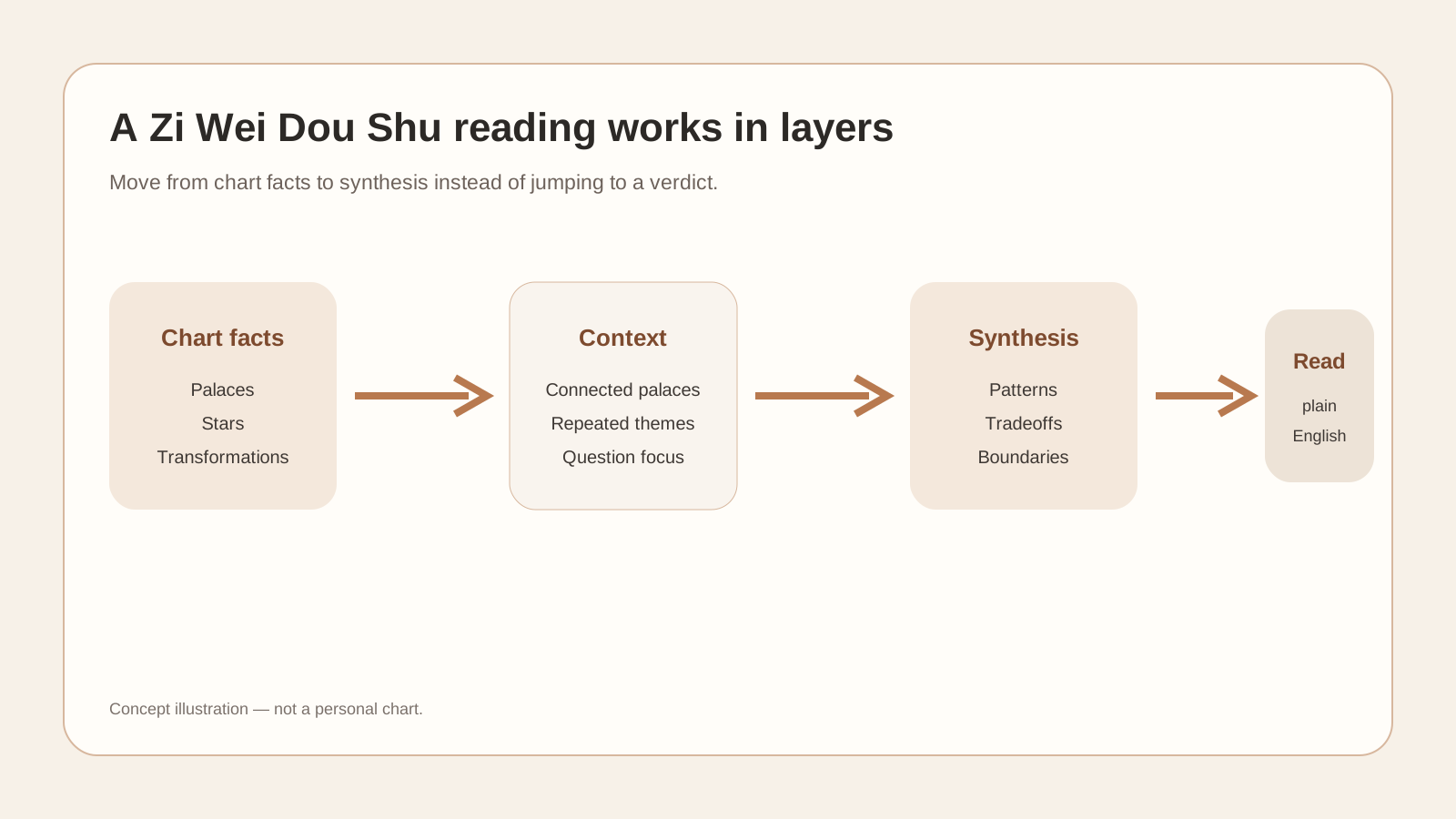
What is the difference between a chart and a reading?
The chart is the calculated structure: palaces, stars, transformations, and other chart data. The reading is the interpretation built from that structure.
That distinction sounds obvious, but it is important. A calculator can be technically correct while the interpretation is weak. The reverse can also happen: a polished reading can sound convincing even when it is using the wrong chart facts.
Start with the chart. If you still need one, see how a Zi Wei Dou Shu calculator works.
A good reading starts with the life area you are actually asking about
Zi Wei Dou Shu organizes the chart into twelve palaces. Instead of treating the whole chart as one personality profile, a reading can focus on the palace relevant to the question.
For example:
- a work question may begin with the Career palace and its connected structure;
- a relationship question may begin with the Spouse palace but should not stop there;
- a money question may begin with the Wealth palace while still checking related palaces and transformations;
- a broader identity question may begin with the Life Palace and Body Palace.
The palace gives the reading a subject. The stars and connections give it texture.
The star is not the conclusion
One of the easiest ways to produce a bad reading is to turn a star into a fixed label: “You have Star X, therefore you are Y.”
A more careful reading asks:
- Which palace contains the star?
- What other major or supporting stars are present?
- What is happening in the opposite and trine-related palaces?
- Do the Four Transformations change the emphasis?
- Is the observation repeated elsewhere in the chart?
This is why learning San Fang Si Zheng is so useful. It moves the reading from one box to a network.
Claims should stay connected to evidence
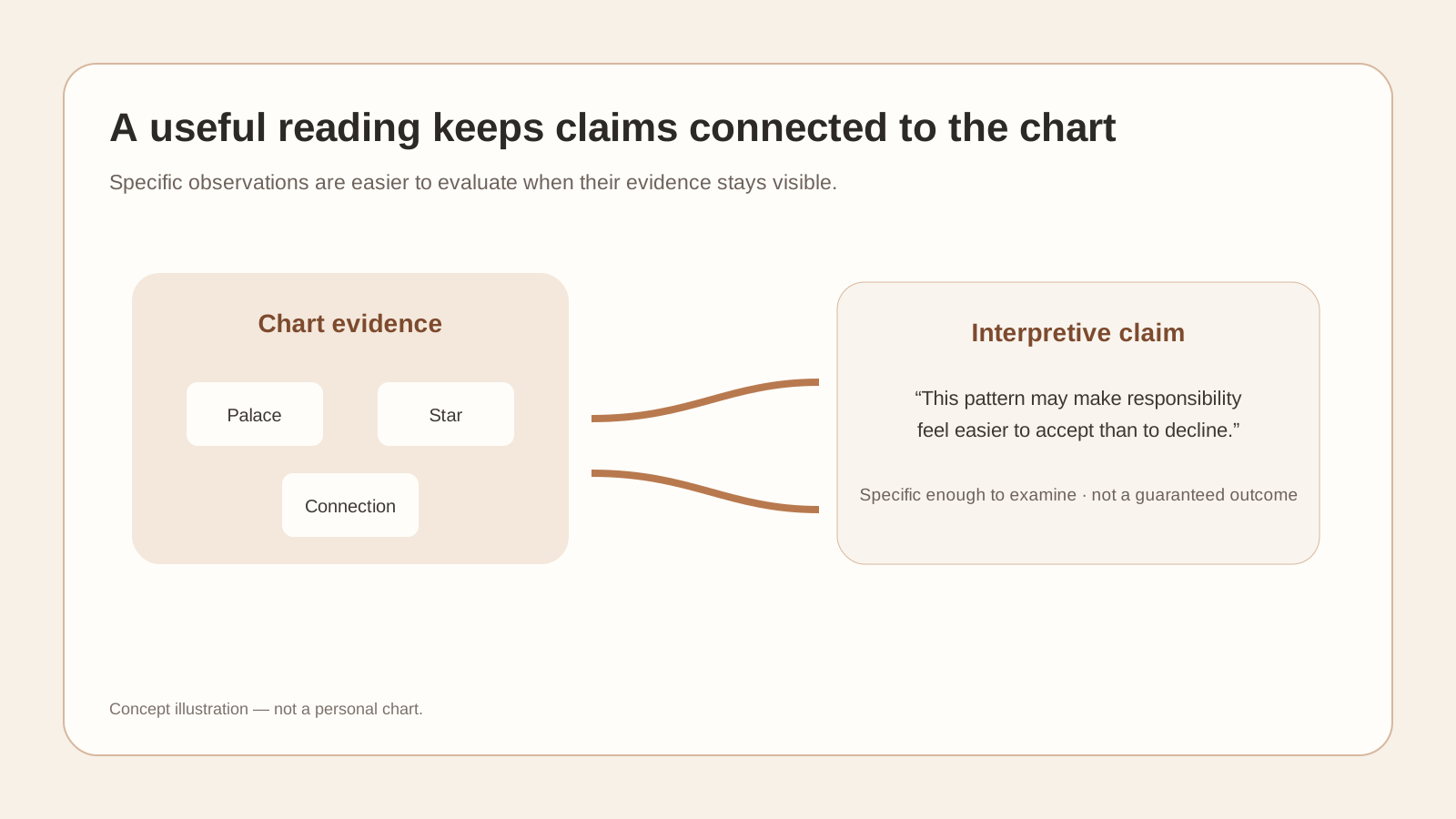
A useful reading makes it possible to ask, “Why are you saying that?” and get an answer that points back to the chart.
That does not mean every sentence needs footnotes. It means the logic should be recoverable. A specific claim may be supported by a palace, a star combination, a transformation, and a connected palace. A weaker claim may only have one signal behind it and should be written more cautiously.
This helps prevent two common problems: generic text that could fit anyone, and overconfident claims stretched far beyond the chart.
What should a full Zi Wei Dou Shu reading cover?
There is no single universal template, and traditional schools differ. But a strong general reading often includes several of these layers:
- Core orientation: Life Palace and Body Palace.
- Major life domains: career, relationships, wealth, family, health, travel, and social environment.
- Major stars: not just their names, but how they behave in the palaces where they appear.
- Connected-palace analysis: especially the broader structure around a focal palace.
- Four Transformations: Lu, Quan, Ke, and Ji as modifiers rather than simple good/bad labels.
- Repeated themes: patterns that appear in more than one place.
- Tensions: places where the chart points in two directions at once.
- Timing: added after the natal structure is understood.
For the main star vocabulary, see The 14 Major Stars of Zi Wei Dou Shu.
What does a good reading sound like?
Compare these two styles:
Too broad: “You are responsible and people rely on you.”
More useful: “This combination puts repeated emphasis on responsibility in work and social contexts. You may find it easier to accept a role than to define where your responsibility ends. Check whether that pattern actually appears in the way you take on projects or help other people.”
The second version is still interpretive, but it gives you something specific enough to examine in real life.
Timing should modify the natal chart, not erase it
Zi Wei Dou Shu can include decade, annual, monthly, and other timing layers. These can add useful context, but a temporary layer should not be treated as a replacement for the natal chart.
A cleaner process is:
- understand the natal pattern;
- identify the relevant life area;
- add the timing layer;
- ask what becomes more active, constrained, or visible;
- avoid turning a temporary signal into a guaranteed event.
This is especially important for dramatic questions about marriage, money, health, or major decisions.
What a reading should not do
Be cautious when a reading:
- uses one star to explain your entire personality;
- cannot show which part of the chart supports a claim;
- mixes BaZi, Western astrology, and Zi Wei Dou Shu rules without explanation;
- turns “challenging” symbolism into a guaranteed bad event;
- claims an exact outcome that the chart does not establish;
- hides uncertainty when birth data is incomplete.
How YUVA approaches Zi Wei Dou Shu readings
YUVA keeps the chart and the explanation as separate but connected layers. The chart gives you the palaces, stars, and structure. Reading adds interpretation in plain English. Ask lets you continue with a more specific question using your own chart context.
The aim is to keep the reading grounded enough that a user can move back from the prose to the chart instead of receiving an untraceable personality report.
If you want the broader workflow, read the step-by-step chart interpretation guide.
Frequently asked questions
Is a Zi Wei Dou Shu reading the same as a horoscope?
No. A natal Zi Wei Dou Shu reading is built from an individual birth chart. A generic horoscope usually addresses a broad sign or group.
Can I read only the Life Palace?
You can start there, but reading it alone loses important context from connected palaces, other stars, and transformations.
How long should a good reading be?
Length is less important than coverage and traceability. A shorter reading with specific chart evidence can be more useful than a long generic report.
Can AI produce a Zi Wei Dou Shu reading?
AI can help explain and synthesize a chart, but it works best when it receives verified chart data instead of guessing from a birth date or a generic prompt.
Start with your YUVA chart →
See the structure first, then decide how deeply you want to interpret it.
YUVA presents astrology and metaphysical traditions for reflection and self-understanding. They are not scientifically validated methods for predicting future events.