To explore friendship in YUVA, start with your own chart and a specific situation, then consider Self Pattern alongside Community & Allies. A Reading can offer language for your way of participating in relationships; Ask lets you bring in the invitation, disagreement, or recurring misunderstanding you want to understand.
This guide is about your part in a friendship, not calculating Western synastry or scoring two people. You do not need your friend’s birth details to do this exercise, and your personal chart cannot establish what they feel or whether you will remain friends.
What Self Pattern and Community & Allies contribute
YUVA’s chart guide introduces its English life-area labels. The underlying method is Zi Wei Dou Shu, which reads symbolic stars in the context of twelve palaces. For a friendship question, two topics give you a useful starting contrast.
| YUVA topic | Focus for this exercise | A question to bring to your Reading |
|---|---|---|
| Self Pattern | Your own orientation and response | What do I tend to do when I want something different from the group? |
| Community & Allies | Your participation in the wider social setting | How do I take part in friendships, shared activities, or collaborations? |
The questions are original prompts, not fixed meanings assigned to particular stars. The palace headings do not tell us what your chart contains. In your own Chart, identify the relevant area and the stars or explanations actually displayed; then use the connected context discussed in your Reading rather than treating one symbol as the answer.
The traditional Friends or Allies palace has a wider scope than one best friend. It can include networks and collaborators. The Siblings palace is also sometimes interpreted through close-peer relationships, depending on the school. YUVA’s palace reference explains these distinctions. They are a reason to name the relationship setting carefully, not a rule that lets you assign each person in your life to a box.
Choose an event before opening the interpretation
Write down what happened, what you said, and what you wanted. A useful starting note is, “I said hiking sounded good, but I wanted a short coffee because I was tired.” A less useful note is, “My friend never understands me.” The first gives you a situation to examine; the second begins with a conclusion about someone else.

Also choose the scale of the question. Being candid with one close friend can feel different from disagreeing in a group. When a reading discusses social confidence, keep those settings separate long enough to see which one you recognize.
A worked example: agreeing to hiking when you wanted coffee
Jordan and Casey are fictional, and no chart has been calculated for them. Jordan suggests a long hike. Casey likes spending time together but has only an hour available. Casey replies enthusiastically without mentioning the limit, then cancels later. Jordan is disappointed.
Casey’s Self Pattern question concerns the moment of agreement: “Why did I express interest before stating what I could offer?” The Community & Allies question concerns participation: “How do I stay involved without treating every invitation as something I must accept?” These are two views of Casey’s own response, not chart-derived explanations of Jordan’s reaction.
Suppose Casey’s actual Reading contains a relevant passage about flexibility or keeping relationships comfortable. Casey can compare that passage with the event. Does it clarify the difference between genuinely wanting to join and wanting to avoid an awkward answer? If the passage does not help, it can stay unused.
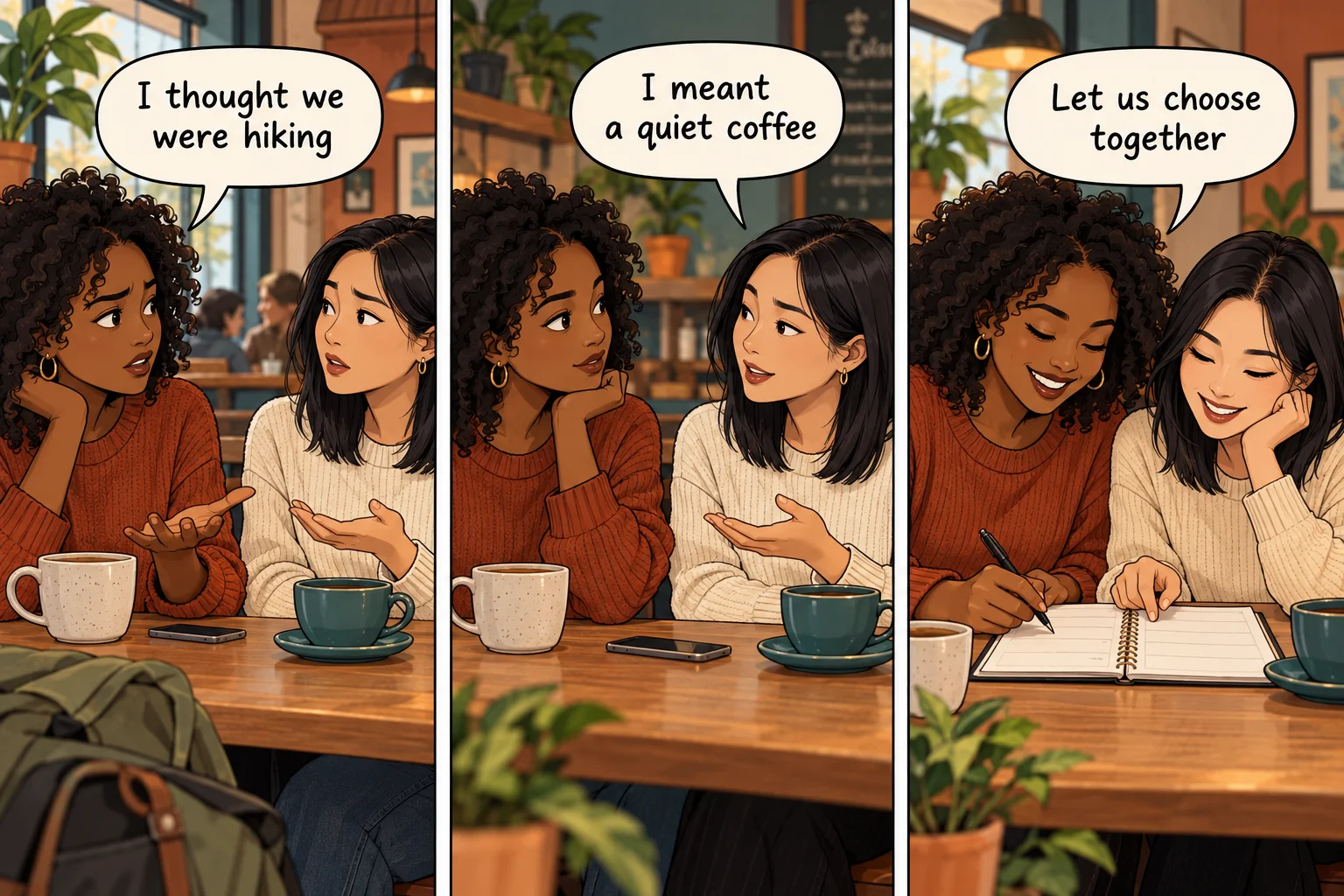
Now add an exception. Casey answers easily when an invitation includes a clear start and end time, but hesitates when the afternoon is open-ended. That detail may be more useful than deciding Casey is simply unreliable or conflict-avoidant. It gives the follow-up a specific contrast to explore.
Turn the comparison into a YUVA Ask question
Ask continues from your own Chart or Reading. You can use a question like this, replacing the scenario with your own:
“I agreed to a friend’s hiking plan even though I only wanted a short coffee, then cancelled. Help me explore the relevant Self Pattern and Community & Allies themes in my Chart or Reading. I answer more clearly when a plan has an end time. What distinction is worth considering here?”
This is an editorial example of a question, not a generated answer or a guarantee that those themes appear in your chart. Include a passage from your own Reading when there is one you want clarified. If there is no relevant passage, ask about the question using your own chart context rather than treating an unrelated paragraph as proof.
The friend does not need to be identified. Paraphrase the event instead of uploading private messages or unrelated records. The aim is to explore your own response, not to persuade an AI to declare who was right.
When the issue is belonging rather than the plan
The same method can distinguish wanting less contact from wanting room to disagree. Imagine you speak freely in a large discussion group, but keep a changed opinion from two longstanding friends. The useful question is not whether you are sociable. It is what you expect will happen in that particular relationship if you express a difference.
Read the relevant social passage with that contrast in mind. A description about joining groups may not answer a question about maintaining an old identity with close friends. You can ask for the distinction explicitly: “Does this passage concern participating in a wider community, or how I respond when someone close to me expects agreement?”
Keep the expectation separate from what the friends have actually said. A personal chart cannot supply their missing response. This is where the exercise returns to a real conversation, rather than expanding into another round of personality labels.
What about a friendship compatibility score?
This personal-chart exercise does not produce one. It is also not a substitute for a two-chart reading. YUVA’s product introduction distinguishes Chart, Reading, and Ask; this guide uses those personal experiences and does not promise a dedicated friendship Match mode.
Whatever a symbolic comparison says, it cannot establish loyalty, consent, safety, or how someone will behave. A reassuring passage is not a reason to overlook repeated disrespect. An uncomfortable symbol is not evidence that a friend intends harm.
For Jordan and Casey, the unresolved practical question remains whether they would enjoy coffee together or prefer another plan. Casey might say, “I want to see you, but I only have an hour. Would coffee work?” That is an ordinary invitation to discuss, not an instruction from a chart.
Begin with your own chart, then return to the friendship
Use the YUVA first-session guide to move from My Star to the wider chart. A known local birth time and verified birthplace are required for a personal chart. My Star is free without an account; your personal Free Reading is free after sign-in and uses 0 Credits. Ask has separate Credit rules; review the displayed maximum before sending. You can view the public fictional sample before entering birth details.
For another relationship setting, read the relationship-patterns guide. It covers reassurance and personal space in close partnership; this article’s focus is participation and clear agreements in friendships and groups.
Explore your own friendship patterns with YUVA. Bring one event and one exception. Leave with a clearer question about your part in the relationship, then hear what your friend actually has to say.
YUVA is for entertainment and self-reflection. The scenarios and prompts are teaching examples, not scientifically validated assessments of friendship or predictions of relationship outcomes.