
Western synastry and YUVA Match both compare two people’s birth charts, but they do not compare the same chart material. Synastry examines relationships between Western natal placements. YUVA Match uses two Zi Wei Dou Shu charts to explore relationship themes through a different palace-and-star framework.
The distinction matters when you already have a Western compatibility report. YUVA will not reproduce its Venus aspects or convert a house overlay into an Eastern equivalent. It offers another way to approach a familiar question: what draws us together, and where do our ways of relating differ?
The comparison at a glance
Synastry is a method used by many astrologers and services. YUVA Match is a particular product. The Western column below describes the method, not a claim that every Western app has identical features, prices, or quality.
| Question | Western synastry | YUVA Match |
|---|---|---|
| What charts are compared? | Two Western natal charts | Two YUVA Birth Charts based on Zi Wei Dou Shu |
| What does the reader examine? | Cross-chart planetary aspects and, with reliable birth times, house and angle relationships | Each person’s palace-and-star context, brought into a relationship comparison |
| What might the output look like? | A double wheel, aspect table, and interpretation; presentation varies by provider | A free two-chart preview, with a separate complete Relationship Reading |
| What is the intended subject? | How the two charts are interpreted together within Western astrology | Attraction, differences in rhythm, and communication in the connection |
| Can the symbols be translated directly? | A planetary aspect keeps its Western meaning and calculation | No conversion from an aspect or house overlay into a YUVA star or palace |
| Does a result decide the relationship? | No chart establishes someone’s intentions or a guaranteed outcome | No chart establishes someone’s intentions or a guaranteed outcome |
For the underlying chart structures, see Western astrology versus Zi Wei Dou Shu. For a common source of confusion, the houses-versus-palaces guide explains why similar life topics do not make the structures interchangeable.
What Western synastry actually reads
Synastry goes beyond comparing two Sun signs. As Cafe Astrology’s synastry introduction explains, each individual has a natal pattern of planetary placements; the comparison then examines relationships between those patterns. An aspect in a synastry table links a factor from one person’s chart with a factor from the other’s.
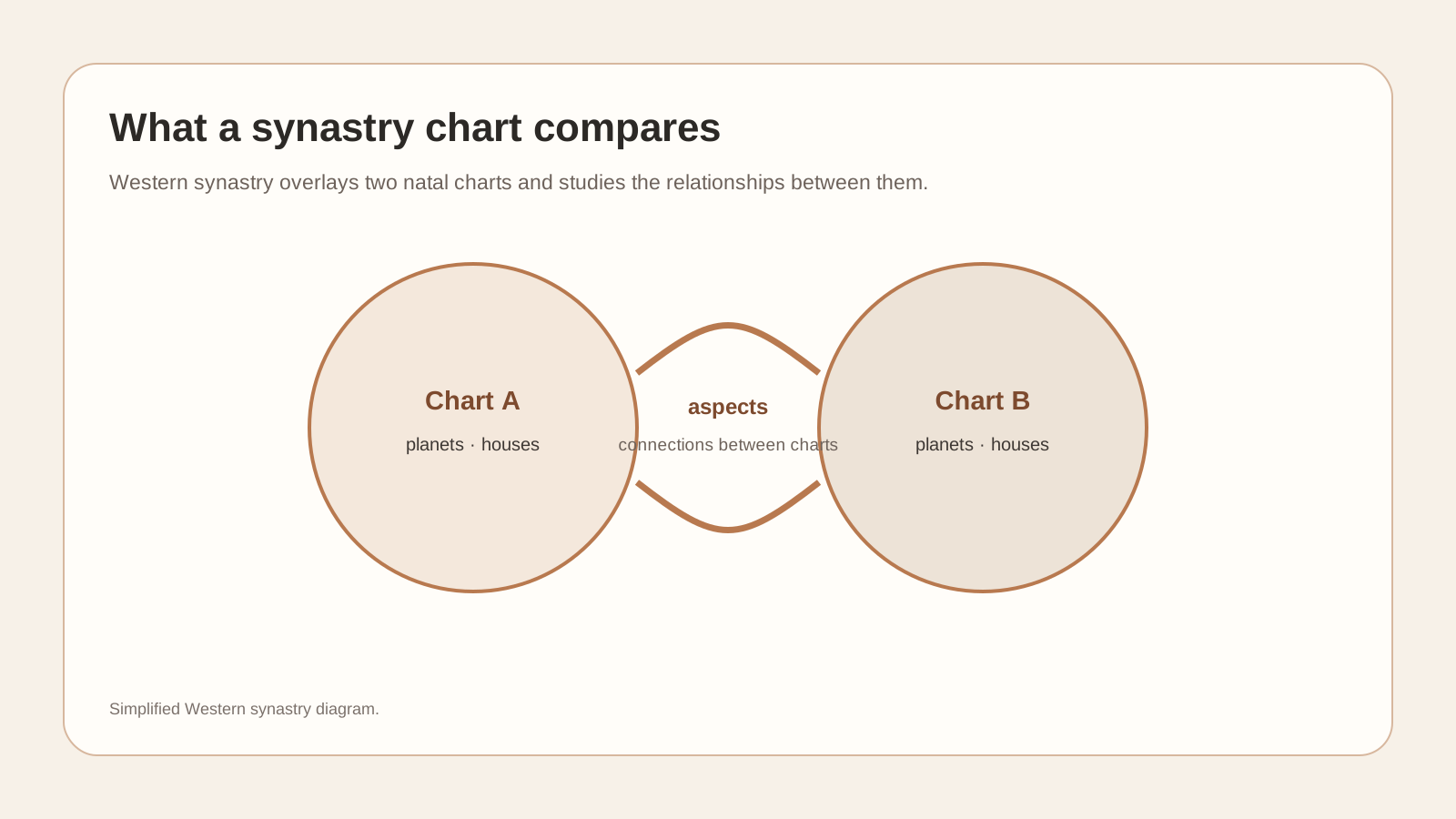
Keep the two owners visible when reading a contact. “Your Venus” and “their Venus” are not interchangeable descriptions, and a favorable-looking contact does not explain the entire relationship. Check the provider’s calculation settings before comparing reports. A polished paragraph and the underlying chart data are different parts of the service.
What changes when you open YUVA Match?
YUVA starts from its own calculated charts, not from the planetary degrees in a Western report. Zi Wei Dou Shu organizes stars across life palaces. A relationship comparison therefore begins with different source material, even when both readings discuss closeness or communication.
The public Match page separates the free preview from the complete Relationship Reading. It presents attraction, differing rhythms, and communication as topics to explore. Its relationship lenses include dating, an established relationship, and uncertainty about a connection. They frame a question; they do not supply a verdict.
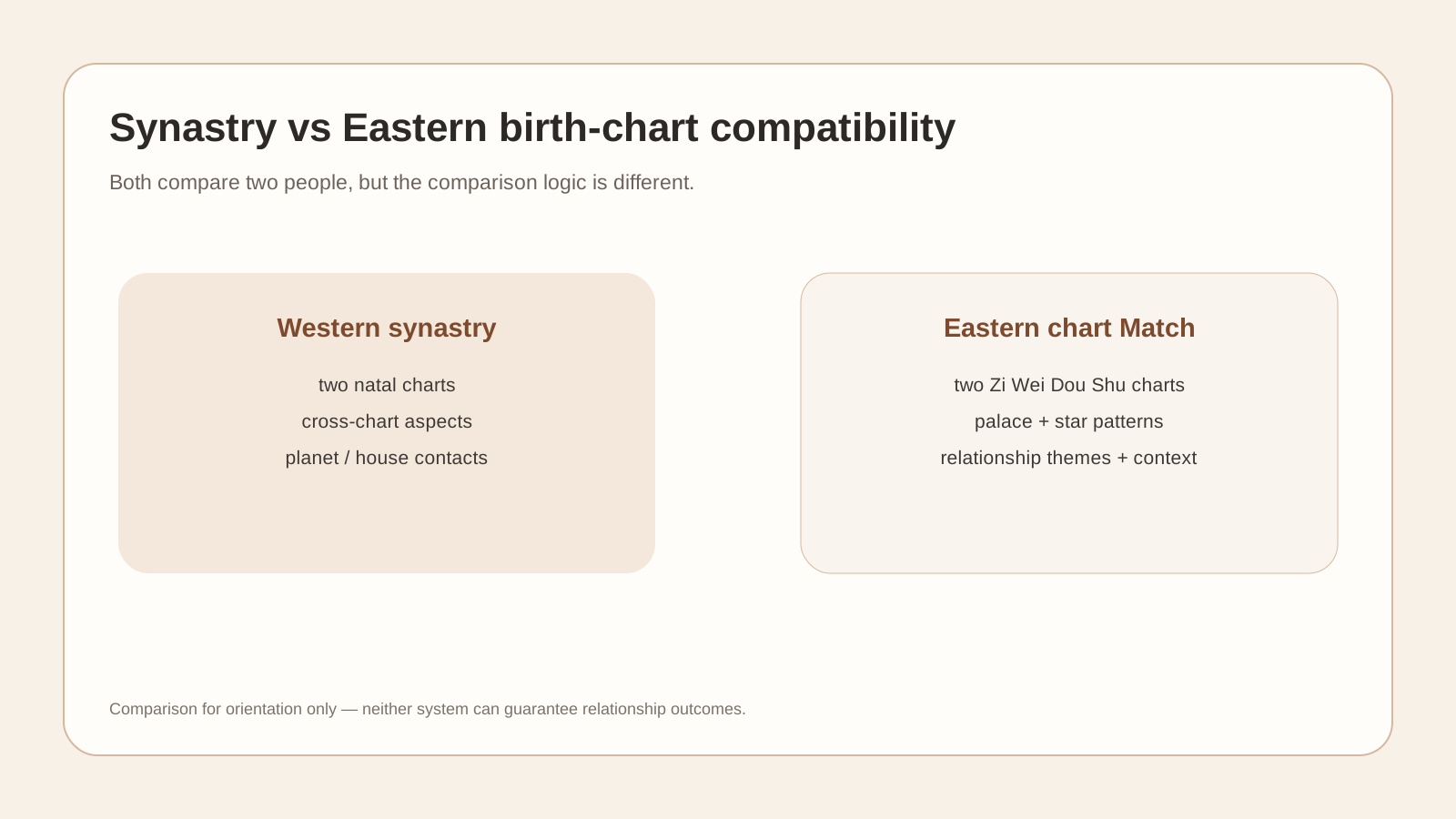
There is no useful step in which “Venus trine Mars” is renamed as a particular YUVA star pair. Likewise, two appealing English star names are not a substitute for the fuller charts. Look for an explanation that makes clear whose pattern it discusses and how the comparison relates to the question.
One relationship question, two reading paths
This scenario is fictional; neither a synastry chart nor a YUVA Match result has been generated for these people. Alex wants to settle weekend plans immediately. Jamie wants time to think. Alex experiences the pause as distance; Jamie experiences repeated questions as pressure.
With Western synastry, begin with their actual natal charts and the relevant cross-chart contacts. A reader would need to explain which placements support the interpretation, rather than inventing a difficult aspect because the story sounds tense. The useful comparison is between the report’s specific explanation and what each person recognizes.
With YUVA Match, begin with their two valid YUVA charts and read the preview’s relationship themes. A passage about different paces would be worth considering only if that passage actually appears. Ask what it says about each side of the interaction; do not assume that one person must be the initiator because of an appealing star label.
In either case, the unanswered question still belongs to the two people: how much time does Jamie need, and when would Alex like an answer? A chart can offer a perspective on that discussion. It cannot answer on either person’s behalf.
A real preview illustration you can inspect before starting
YUVA’s public illustrative preview pairs The Radiator and The Harmonizer with the line, One brings momentum. The other makes room to stay.
It is labeled as an illustration, not a result calculated for you.
That example shows the style of the comparison: two contributions are placed in relation to each other rather than collapsed into a percentage. For the fictional weekend-plan scene, it might prompt a discussion about when different paces complement one another. It does not establish that Alex and Jamie have those stars, or that their personal result will contain the same sentence.
This is a concrete way to compare reading experiences before supplying birth details: inspect a Western provider’s sample aspect interpretation and YUVA’s public illustration, then decide which kind of explanation you want to explore. Neither sample is evidence about your own relationship.
Birth details and permission come before the comparison
Have both people’s birth dates and known local birth times ready. Complete the current form’s chart inputs, including its birthplace-selection steps. Do not convert an uncertain time into an exact one just to finish the form, and do not assume that an unknown-time mode in a Western service is supported in YUVA.
Birth-time uncertainty limits what a chart can establish, especially time-dependent structures. The birth-time guide discusses those boundaries. Obtain permission before submitting another person’s details, and avoid using a reading to secretly classify a partner’s feelings or loyalty.
Free personal Reading, free Match preview, paid Relationship Reading
These are separate offers. YUVA’s personal Reading is free after sign-in and uses 0 Credits. It interprets your own chart; it is not the complete two-person report. The updated calculator guide explains that personal route.
The two-chart Match preview is also free, without an account. As checked on October 13, 2026, the public Match page lists the complete Relationship Reading as a separate sign-in experience costing 20 paid Credits; Starter and reward Credits are not accepted for that report. Review the offer displayed in the app before generating it. Ask has its own Credit rules and should not be assumed to provide a two-chart follow-up merely because you have a Match.
Which experience fits what you are looking for?
Choose a Western synastry service when you specifically want planetary aspects, house overlays, or an explanation of an existing Western chart comparison. YUVA is not a replacement calculator for those details.
Explore YUVA Match when you want a different chart-based perspective on a relationship and are interested in its English-language preview. Start with the public illustration, then create your free two-chart preview using details you have permission to use.
For a question about your own relationship habits rather than a comparison of two people, the personal relationship-patterns guide is a separate route. A personal reflection and a two-chart comparison need not be treated as the same task.
These are symbolic, interpretive approaches—not scientifically validated compatibility tests. Respect, safety, consent, and the way people actually treat one another matter more than a reassuring or unsettling reading.