The 12 palaces in Zi Wei Dou Shu organize the chart into different areas of life. They are one of the easiest ways to understand the system visually: instead of reading one long list of symbols, you can see where a pattern is showing up—identity, relationships, money, career, health, travel, family, and other domains.
But a palace name is only the starting point. You still need to read the stars inside it, the palaces connected to it, and the transformations or timing layers that change the emphasis.
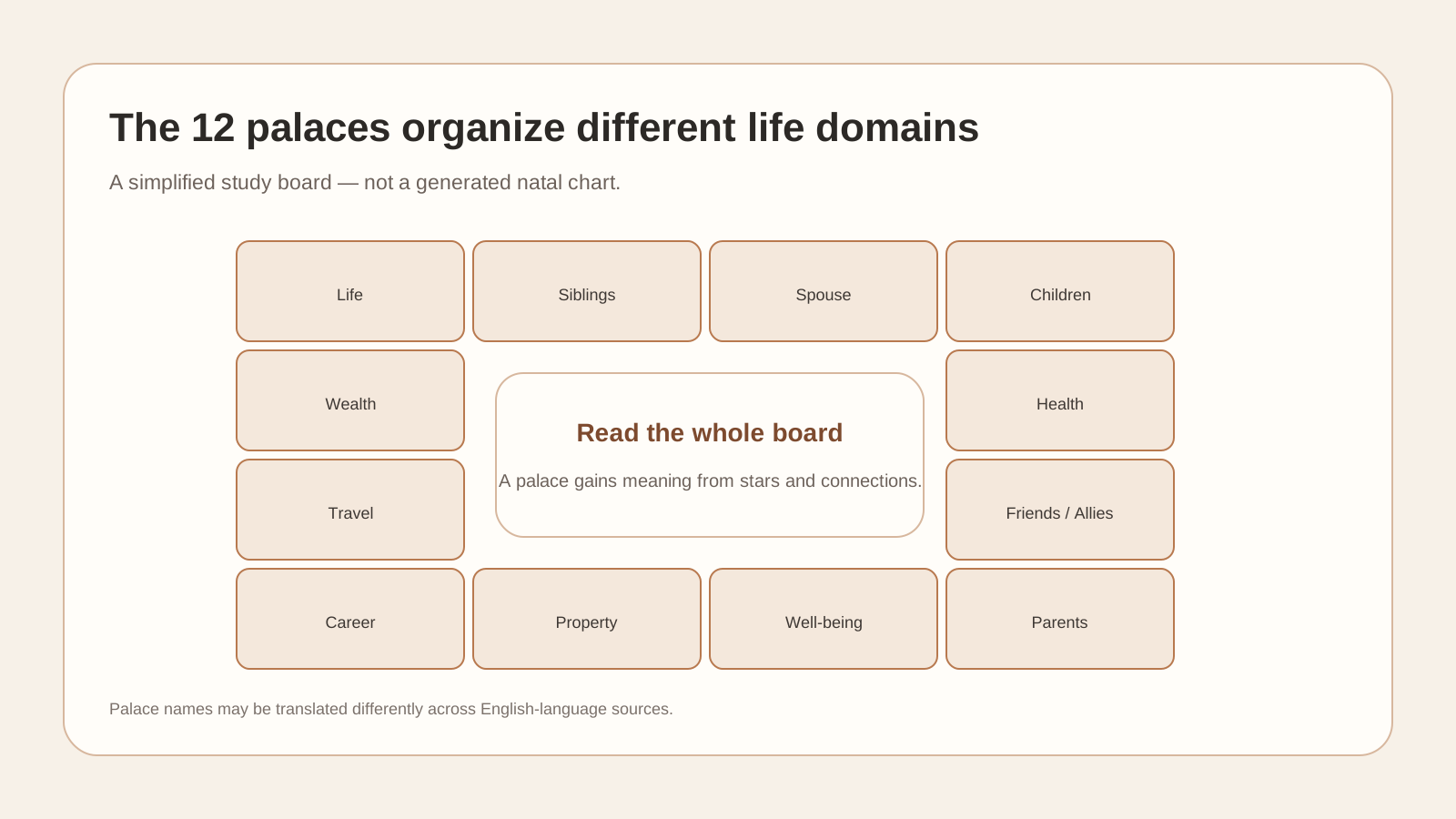
The 12 palaces at a glance
English translations vary by school and publisher, but the standard palace set is usually presented roughly as follows:
| Palace | Chinese | Common themes |
|---|---|---|
| Life | 命宮 | Core orientation, identity, life direction |
| Siblings | 兄弟宮 | Siblings, peers, close cooperative relationships |
| Spouse | 夫妻宮 | Romantic partnership, marriage, relationship dynamics |
| Children | 子女宮 | Children, younger people, creativity or legacy themes in some readings |
| Wealth | 財帛宮 | Money, earning patterns, material resources |
| Health | 疾厄宮 | Health-related themes and physical constitution in the traditional system |
| Travel | 遷移宮 | Movement, relocation, outside environments, public-facing context |
| Friends / Allies | 交友宮 / 奴僕宮 | Friends, networks, collaborators, social support |
| Career | 官祿宮 | Work, vocation, public role, professional direction |
| Property | 田宅宮 | Home, property, living environment, family assets |
| Well-being | 福德宮 | Inner life, enjoyment, mental or spiritual orientation |
| Parents | 父母宮 | Parents, elders, authority or support from older generations |
Some modern English products rename these areas to make them easier to understand. That can be useful, but the underlying palace relationships matter more than the wording of the label.
1. Life Palace: where many readings begin
The Life Palace is a natural starting point because it helps frame the chart’s overall orientation. It can be used to discuss recurring personality patterns, life direction, and how the chart tends to organize itself around the person.
Do not treat it as the entire personality. A chart with a strong Career or Travel emphasis, for example, may express very differently depending on how those palaces connect back to Life.
The Body Palace adds another layer and should be read alongside the Life Palace rather than merged into it.
2. Siblings Palace: more than literal siblings
Traditionally, this palace concerns brothers and sisters. Modern readers may also use it to explore peer dynamics and how the person relates to people in a roughly equal social position.
The exact scope depends on the school. This is a good example of why English labels should be treated as guides, not rigid definitions.
3. Spouse Palace: relationship structure, not a guaranteed partner
The Spouse Palace is commonly used for marriage and romantic partnership. A careful reading looks at the stars, transformations, and connected palaces rather than making a one-line claim such as “you will marry late” from one placement.
Relationship questions are especially vulnerable to overstatement. The chart can be used as a framework for discussing tendencies, expectations, and tensions, but it should not be treated as proof of a future relationship outcome.
4. Children Palace
This palace traditionally relates to children and the relationship with younger generations. Some contemporary readings also extend its symbolism toward creativity, projects, or what a person produces and passes forward.
Because those broader meanings vary more by interpretive school, it is useful to distinguish traditional scope from modern extension.
5. Wealth Palace
The Wealth Palace concerns material resources, earning patterns, and the way money is handled. It does not by itself reveal a guaranteed income level.
A useful reading may compare Wealth with Career, Life, and the connected palace network to see whether the financial theme is reinforced by work, opportunity, risk, stability, or other patterns.
6. Health Palace
The Health Palace is part of the traditional system, but it should never be treated as a medical diagnostic tool. Astrology is not a scientifically validated method for diagnosing illness.
Within the chart tradition, readers may use this palace to discuss constitution, energy, stress, or health-related symbolism. Real health decisions belong with qualified medical care.
7. Travel Palace
The Travel Palace is often associated with movement, relocation, external environments, and how life changes when you move beyond familiar settings. It can also add context to how a person is perceived or functions in the outside world.
Its relationship with the Life Palace is especially useful because the two often provide a contrast between the familiar self-context and the person operating elsewhere.
8. Friends / Allies Palace
This palace appears under different English labels because older terminology and modern social language do not map perfectly. It can cover friends, collaborators, networks, subordinates, helpers, or people who participate in your wider social environment.
The translation matters less than the chart role: it helps describe the social field around the person.
9. Career Palace
The Career Palace, traditionally 官祿宮, is used for work, vocation, professional roles, responsibility, and public contribution.
It should not be read as a job-title generator. Instead, look at the kinds of work patterns and role expectations repeated across Career, Life, Wealth, and connected palaces.
10. Property Palace
The Property Palace traditionally concerns homes, land, property, and the family environment. In modern readings it can also become a useful way to discuss what makes a living situation feel stable or unsettled.
11. Well-being Palace
The Well-being or Fortune Palace, 福德宮, often points toward inner life, enjoyment, mental orientation, rest, and what a person experiences as meaningful or replenishing.
It is not a simple “happiness score.” Its stars and connections matter.
12. Parents Palace
The Parents Palace traditionally concerns parents and older generations. Depending on the school, it can also be used to discuss authority, support, inheritance of expectations, or relationships with senior figures.
Why one palace is never enough
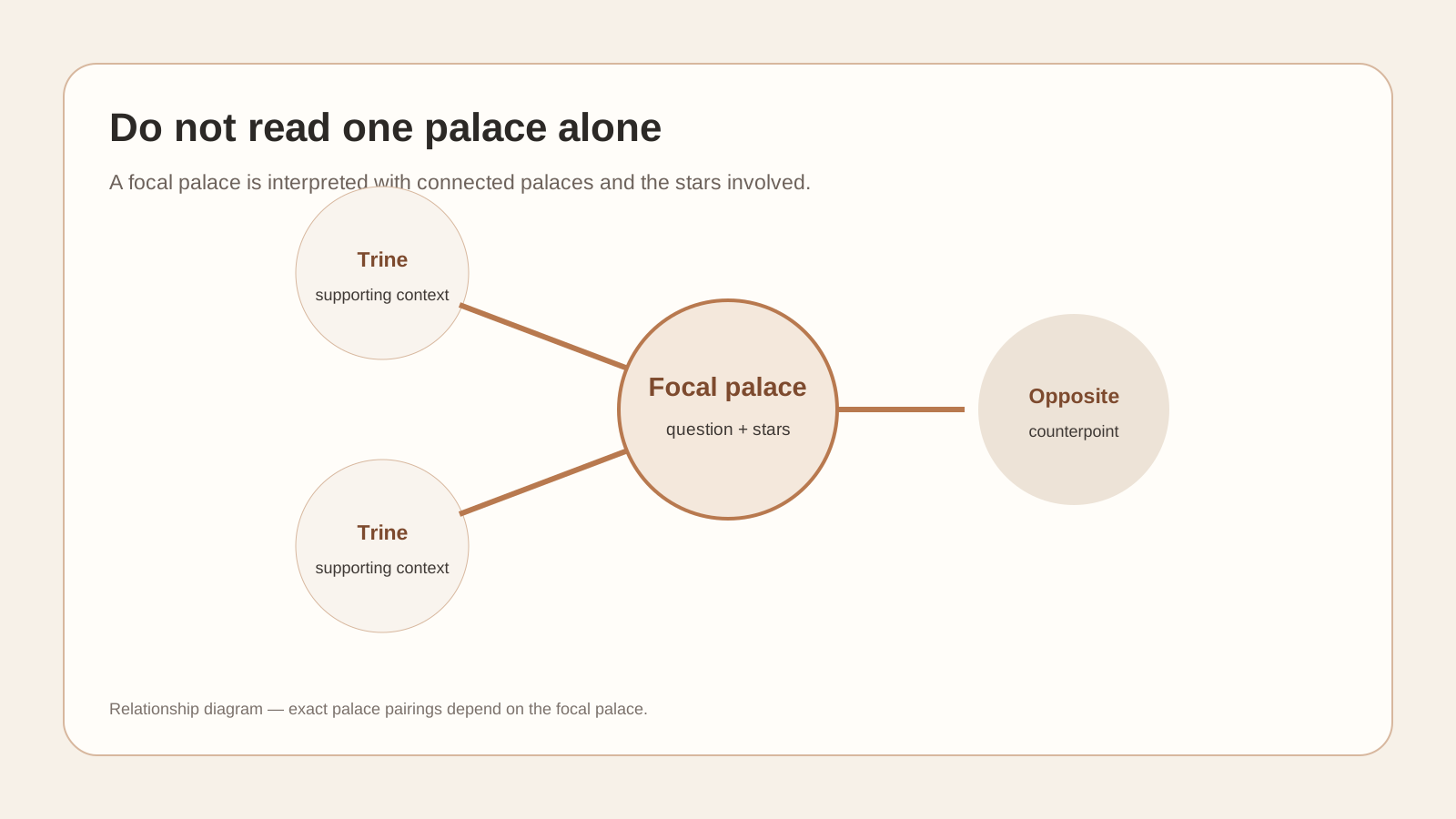
One of the most important Zi Wei Dou Shu habits is to stop treating each palace as an island.
San Fang Si Zheng connects a focal palace with its wider trine and opposite structure. That relationship helps you see whether another palace reinforces, redirects, or complicates the theme.
This is why two people with the same major star in the same palace can still receive different readings when the rest of the structure differs.
What if a palace has no major star?
An “empty” palace does not mean that area of life is absent. In Zi Wei Dou Shu, an empty major-star field is interpreted through the wider chart context, especially the opposite and connected palaces, supporting stars, and other chart factors.
See Empty Palaces in Zi Wei Dou Shu for a more focused explanation.
How the Four Transformations change a palace reading
Lu, Quan, Ke, and Ji can add emphasis or modify how a theme is expressed. They should not be reduced to “four lucky/unlucky labels.”
Instead, ask what transformation is attached to which star, where that star appears, and how the transformed theme interacts with the palace network.
For the basics, read The Four Transformations in Zi Wei Dou Shu.
A simple order for reading the 12 palaces
- Find the Life Palace and Body Palace.
- Identify the major stars in the palace you care about.
- Check the opposite and trine-connected palaces.
- Add supporting stars and brightness or condition labels if your system uses them.
- Add the Four Transformations.
- Compare repeated themes across multiple palaces.
- Add timing layers only after the natal structure is clear.
This sequence keeps the reading structured without forcing you to understand the entire chart at once.
Frequently asked questions
Are the 12 palaces the same as the 12 houses in Western astrology?
No. Both systems divide a chart into life areas, but the calculation, labels, symbolic logic, and relationships are different.
Which Zi Wei Dou Shu palace is the most important?
The Life Palace is a common starting point, but no single palace explains the whole chart. The question you are asking determines which palace deserves focus.
Can a palace change over time?
The natal chart remains the base structure. Timing techniques add period-specific layers that can change which themes are emphasized.
Why do English palace names differ?
Translations and modern adaptations vary. Compare the traditional Chinese palace name and the chart role rather than assuming every English label is standardized.
See your 12-palace chart in YUVA →
YUVA presents astrology and metaphysical traditions for reflection and self-understanding. They are not scientifically validated methods for predicting future events.