
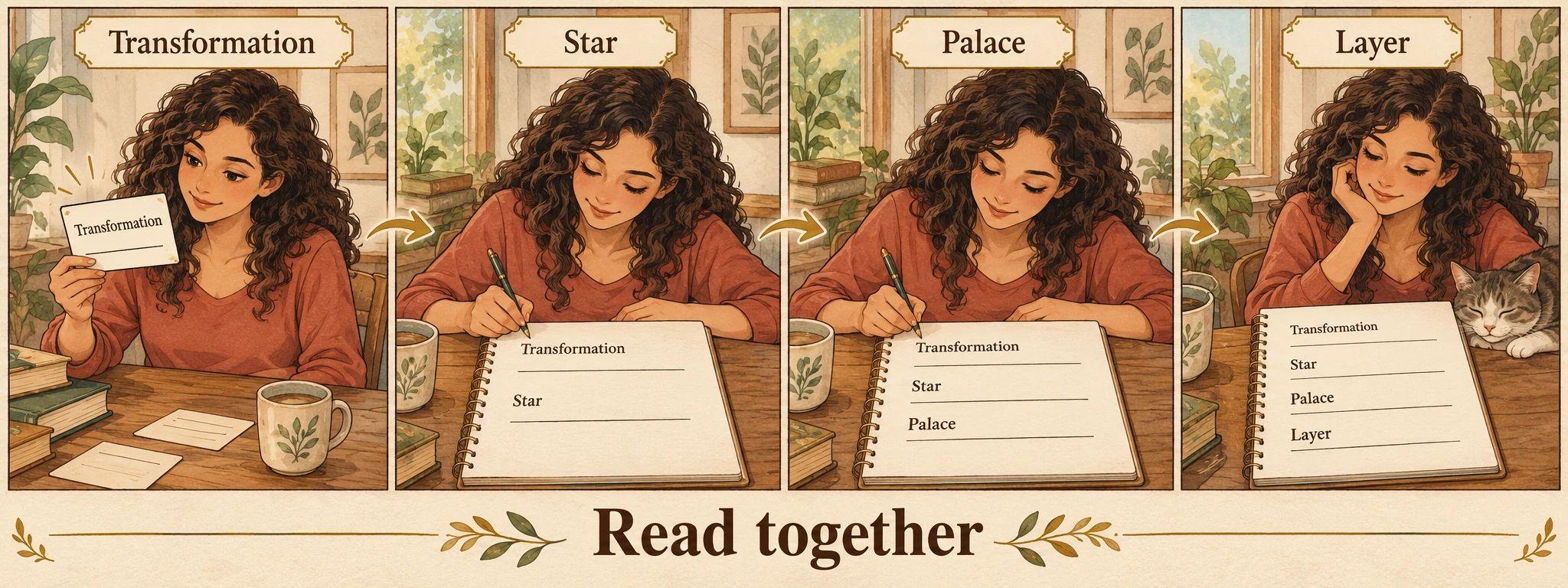
The Four Transformations in Zi Wei Dou Shu are Hua Lu, Hua Quan, Hua Ke, and Hua Ji. Together they are called Si Hua (四化). These labels modify how particular stars are interpreted: Lu is associated with resources and ease, Quan with authority, Ke with recognition, and Ji with obstruction or entanglement. A useful first reading records the transformation, the star carrying it, its palace, and the chart layer.
If you have found 禄, 权, 科, or 忌 beside a star name, start there. The small label needs its surrounding information before it can contribute to a reading. This guide explains the vocabulary and gives you a way to keep that information together.
What the transformation label belongs to
In a natal, or birth-chart, reading, the heavenly stem of the birth year determines which stars receive the four transformations. A heavenly stem is one part of the traditional Chinese calendar cycle. The selected stars can occupy different palaces in different charts, so a shared birth-year stem does not produce an identical reading. Wudang’s guide to transformations explains this distinction.
Think of a transformation as an annotation on a star. The star supplies a set of traditional associations; the palace supplies a life topic. The annotation changes how those associations are discussed. Some auxiliary stars also receive transformations, so you will not necessarily find every label attached to one of the fourteen major stars. FateForge’s reference includes both categories.
The four labels in plain English
English translations vary. Keep the pinyin and Chinese label in your notes so you can recognize the same concept across books and chart tools. The questions below are optional reflection prompts, rather than predictions or traditional calculation rules.
Hua Lu 化祿 or 化禄
Lu is often translated as prosperity. Its traditional associations include availability, enjoyment, resources, and relatively smooth progress. The relevant resource depends on the rest of the reading; interpreting every Lu as a promise of money loses that context.
For reflection, ask: What seems readily available in this part of my life? What effort makes that possible? Consider time, support, knowledge, and material resources separately, rather than assuming they always arrive together.
Hua Quan 化權 or 化权
Quan is commonly translated as power or authority. Traditional readings connect it with initiative, responsibility, influence, and the wish to direct events. A reader may also discuss pressure or a tendency to overcontrol. Sheng Pin Kai’s explanation describes authority and decisiveness among its central themes.
A practical question is: Where do I have the authority to make a decision, and where do I need agreement? Write down an actual responsibility before deciding that a general description of leadership fits you.
Hua Ke 化科
Ke is associated with distinction, reputation, refinement, and learning. Traditional explanations often mention scholarship or examinations. In contemporary language, readers may discuss credibility or how someone’s work is received. These associations describe the interpretive vocabulary; they do not establish future academic or professional success. ZWDSIN’s overview identifies reputation and cultural cultivation as Ke themes.
Ask: What would make my contribution clearer or more credible to other people? A specific answer, such as explaining a decision more carefully, is more useful than expecting recognition because a label appears.
Hua Ji 化忌
Ji is usually translated as obstruction. It carries traditional associations with difficulty, entanglement, and strong preoccupation. Some contemporary readings also explore persistence or attachment. The important question is how the reader connects that vocabulary to the particular star and palace. FateForge discusses Ji in this contextual way.
Ask: What concern keeps returning, and what evidence do I have about it? Leave room for an ordinary explanation, such as an unresolved conversation or an unrealistic workload. A Ji label alone cannot establish that something bad will happen.
How to read a transformation on your chart
1. Check the chart legend
Look for the full transformation name or its Chinese character. Different tools may use color, short labels, or other markers. If you cannot tell what a mark means, check the tool’s explanation before comparing it with an article. Color alone is an unreliable identifier across products.
2. Copy the star name exactly
Record the name receiving the label. Preserve its Chinese characters if available, especially when two sources use different English translations. Avoid reducing the note to “I have Ji.” Your next question should be “Which star carries Ji in this view?” The American Feng Shui Institute’s teaching material likewise stresses identifying the transformed star when marking the chart.
3. Record the palace name
Find the palace containing that star and write its displayed name. Keep the topic specific as you read. An explanation about work requires a different discussion from one about a close relationship, even when the same broad word, such as responsibility, appears in both.
4. Identify the layer
Check whether you are viewing natal information, a ten-year period, or an annual layer. Traditional readings can combine these, but your notes should distinguish them. Sheng Pin Kai describes these overlapping time frames. If a selected year changes what you see, record that year with the label rather than treating the new view as a correction to the birth chart.
5. Ask what else supports the interpretation
Now read the explanation of the star and its surrounding chart context. Ask which other placements or relationships the reader is using. Keep an unanswered question if the connection remains unclear. You do not need to turn every symbol into a personal conclusion on your first pass.
A compact reading note can contain these five lines:
- Transformation name and character:
- Star carrying the transformation:
- Palace shown in this view:
- Natal, ten-year, or annual layer:
- Interpretation offered and question still open:
Why another chart or guide may disagree
First check that both views use the same birth information and time layer. Then look at the transformation table or school named by each source. Established traditions differ on some assignments. Wudang notes these table variations, which is why this beginner guide does not present one table as universal.
You may also encounter flying transformations or self-transformations. These introduce additional relationships based on palace stems. If a reading uses arrows or discusses a transformation coming from another palace, ask which method it follows before applying the simpler natal-label steps to it.
When comparing explanations, save the exact disagreement. “These sources attach Ke to different stars” is something you can investigate. “My chart is wrong” skips over the information needed to find out what happened.
Using this vocabulary with YUVA
YUVA offers birth-chart readings based on Zi Wei Dou Shu. Its introduction to Zi Wei Dou Shu explains the system’s symbolic stars and palaces. The YUVA Birth Chart overview explains how that tradition relates to YUVA’s readings.
Bring one precise question to a reading: “Which star carries this transformation, in which palace, and at what layer?” That gives you a clearer starting point than asking whether your chart is lucky.
Common questions
Does everyone have Hua Ji?
A natal transformation set assigns one Lu, one Quan, one Ke, and one Ji. Seeing Ji is therefore an ordinary part of this chart system. Check the display settings or legend if you cannot find it.
Does Hua Lu cancel Hua Ji?
There is no useful beginner rule that lets you erase one label with another. Keep both in your notes and ask how the reading combines their stars, palaces, and layers.
Can I read Si Hua without learning every star?
You can learn the four labels first. For a particular placement, learn the receiving star and its palace next. That small, connected piece of study is a workable place to begin.