
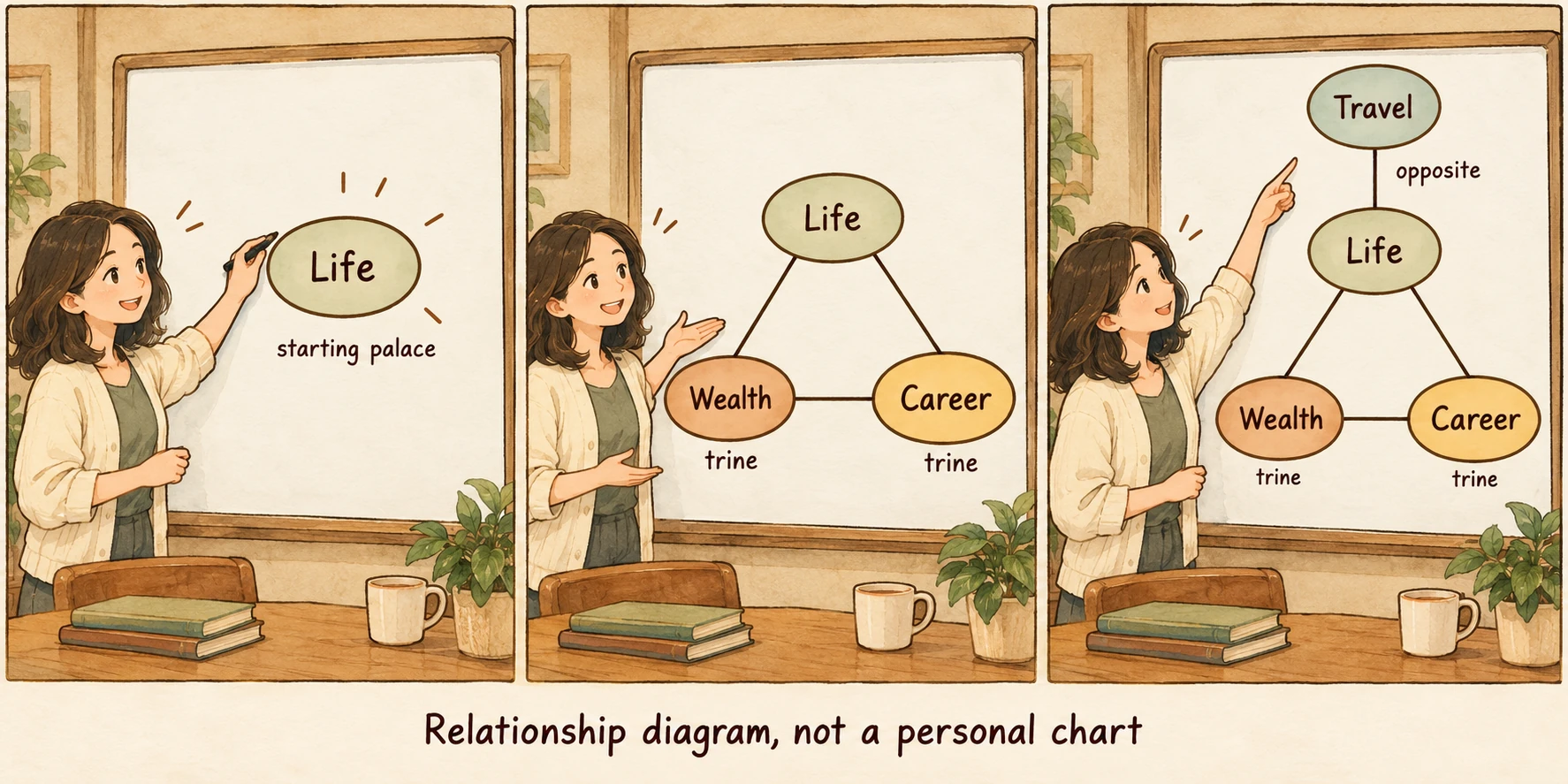
San Fang Si Zheng (三方四正) is a way of reading four connected palaces in Zi Wei Dou Shu: the palace you are studying, the palace opposite it, and two trine-related palaces. When you begin with the Life Palace, the group is Life, Wealth, Career, and Travel. The connections tell you where to look before you decide what the stars might mean.
If you know the twelve palace names but lose track when a reading jumps between them, start here. You do not need to memorize every star to trace this structure. First identify the four places. Then keep their information separate long enough to understand how the reading connects them.
The four-palace frame
Picture the starting palace and its two trine partners as a triangle. Add the opposite palace to make the four-palace reading frame. You are considering four palaces altogether.
English guides use different translations, including “Three Directions and Four Uprights” and “Three Harmonies and Four Cardinals.” Keeping the pinyin name beside the definition is easier than trying to infer the method from an English title. Ziwei AI’s chart-reading guide explains the Life Palace group as a triangle of Life, Wealth, and Career, completed by Travel across from Life.
Find the starting palace, opposite, and two trines
Three labels help you follow a traditional explanation:
- Ben Gong (本宮), the starting palace: whichever palace you are currently examining. It does not always mean the Life Palace.
- Dui Gong (對宮), the opposite palace: the single position halfway around the twelve-palace ring.
- Two San He Gong (三合宮), the trine palaces: the two positions that form a three-part group with your starting palace.
To locate them by counting, treat your starting position as zero. Move four palace positions around the ring in each direction for the two trines. Move six positions for the opposite. If you count the starting box as one instead, these are the fifth positions and the seventh position. Mixing the two counting conventions is an easy way to land in the wrong box. Fortune Cloud’s explanation gives both the positions and a palace-by-palace reference.
Follow the ring of twelve positions, even if the chart is drawn as a rectangle. Do not select boxes merely because they look diagonally close on the screen. When your chart has a connection-highlighting feature, use the labels to check what the highlighted lines actually join.
A structural example with Life, Wealth, Career, and Travel
Use the Life Palace as your starting point. The four roles are:
- Life, Ming Gong (命宮): the starting palace; traditionally associated with the person’s basic character and approach.
- Wealth, Cai Bo Gong (財帛宮): one trine partner; associated with earning and the handling of resources.
- Career, Guan Lu Gong (官祿宮): the other trine partner; associated with work and public activity.
- Travel, Qian Yi Gong (遷移宮): the opposite palace; associated with the outside environment and engagement beyond familiar surroundings.
This is a map of relationships, without anyone’s birth data or star placements. sǹg-miā’s Life Palace reference lists these four roles. The American Feng Shui Institute’s introductory course, printed page 2-20, also describes the Life–Wealth–Career triangle and the Life–Travel connection.
You can sketch three labeled circles for Life, Wealth, and Career, connect them as a triangle, then draw a separate line from Life to Travel. Label that line “opposite.” This simple sketch records the relationships without pretending to reproduce a calculated chart.
The group belongs to Life as the starting point. If you switch to a different starting palace, find its own opposite and trines again. Carrying the same four names into every topic would lose the structure you just learned.
Make a four-part reading note
Give each connected palace its own space on a page. Under every palace name, copy the star names exactly as they appear, followed by any status or transformation labels you can identify. Leave unfamiliar labels intact rather than guessing a translation.
- Starting palace: What is visibly placed here? What question am I bringing to this part of the reading?
- Opposite palace: What is placed across from it? How does the explanation connect those two topics?
- First trine: What additional theme does this palace introduce?
- Second trine: What information would be missing if I ignored this palace?
For each entry, leave two short lines: “Chart label” and “Interpretation.” On the first, copy what you can point to. On the second, summarize what the reader says it means. That separation makes it easier to return to a confusing statement and ask whether the issue is a mislabeled position, an unfamiliar word, or an interpretive assumption.
Read the connections without losing the original placements
Begin with one question, such as “Which chart signals does this explanation use when discussing my approach to work?” Locate each cited signal in your four-part note. A statement that names several stars should still make clear which palace contains each one.
Stars in the same palace and stars in connected palaces are different relationships. Traditional readers may describe a star as “meeting” another across the chart. That wording does not move it into the same box. This distinction is explained in sǹg-miā’s discussion of same-palace and connected-palace readings.
Next, check whether the explanation has actually used all four areas or simply listed them. Ask for one sentence explaining each connection. “These palaces support the reading” is hard to evaluate. An explanation that identifies a particular label, its location, and the theme it contributes gives you something concrete to examine.
Keep birth-chart information separate from decade or annual information. A note that begins with natal Life and then silently changes to an annual palace is difficult to follow. Write the time layer at the top of your page, and ask the reader to name any change of layer before continuing.
Finally, compare the interpretation with your experience. You can understand the traditional reasoning without accepting every conclusion. If a description seems broad enough to fit almost anyone, ask what specifically led to it and what other reading of the same symbols is possible.
Common questions
Are the neighboring palaces part of the four?
No. The two adjacent palaces belong to a separate neighboring or flanking relationship. For this exercise, stay with the starting palace, its opposite, and its two trines.
Does an opposite palace automatically mean conflict?
No. “Opposite” identifies a position. Traditional interpretations can discuss support, tension, or complementary themes across that connection. The word alone does not decide which applies.
Can I ignore the connections if my Life Palace has a major star?
The four-palace approach still considers the connected group. Having a major star in the starting palace does not remove the other positions from the method.
Bring a clearer question to your YUVA reading
If the vocabulary is still new, begin with YUVA’s introduction to Zi Wei Dou Shu. The YUVA birth chart guide explains how Chart, Reading, and Ask relate to one another. YUVA uses Zi Wei Dou Shu for birth-chart readings, and Ask supports follow-up questions grounded in your Chart or Reading.
A useful question to take into YUVA is: “Which palace is the starting point here, and what does each connected palace add to this explanation?” Keep your four-part note beside the answer. Treat the result as a traditional interpretation for reflection, and use real-world evidence when making decisions.