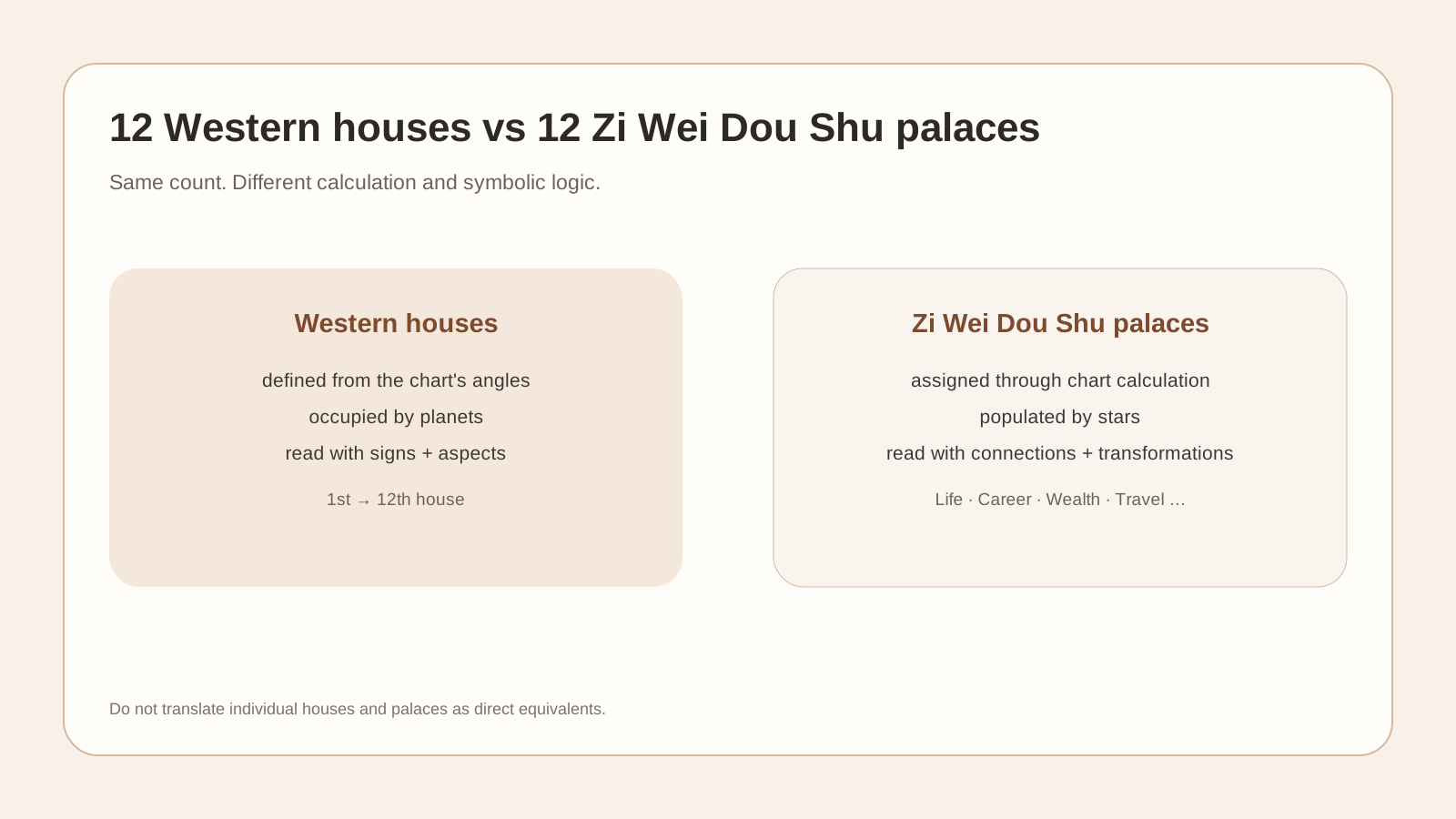
Western astrology has 12 houses. Zi Wei Dou Shu has 12 palaces. That shared number makes comparison tempting—but the two structures are not interchangeable.
Both systems use chart areas to organize life topics. The similarity mostly ends there. They are calculated differently, populated with different symbols, and connected through different interpretive rules.
How Western astrology houses work
Western houses divide the natal chart into twelve sectors associated with areas of life. Their boundaries are defined through the chart’s angles and the chosen house system.
Planets occupy houses, zodiac signs color those placements, and aspects connect planets across the chart.
How Zi Wei Dou Shu palaces work
Zi Wei Dou Shu also uses twelve life domains, but the chart is built through a different calendrical and symbolic system. The palaces contain major and supporting stars and are interpreted with connected-palace structures and the Four Transformations.
For the full palace list, see Zi Wei Dou Shu 12 Palaces.
Are the life topics similar?
Some questions overlap because both systems address ordinary human life: identity, work, money, relationships, home, family, and inner life.
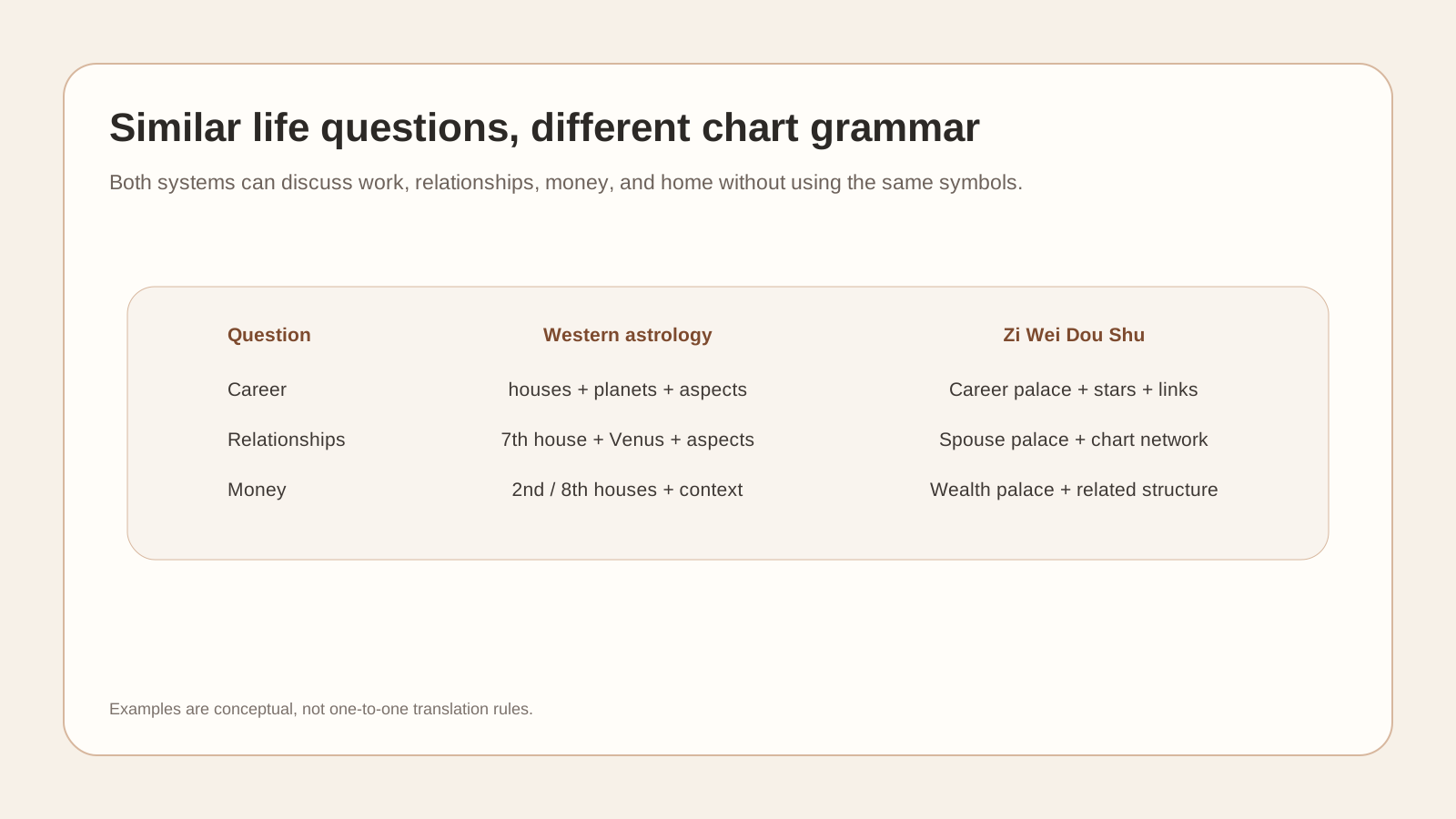
For example, a Western astrologer might examine career through the 10th house, its ruler, planets, and aspects. A Zi Wei Dou Shu reader might begin with the Career Palace and then examine its stars, transformations, and connected palaces.
Those are analogous questions, not identical calculations.
Why “1st house = Life Palace” is too simplistic
The 1st house and Life Palace both participate in identity-oriented interpretation, so beginners often pair them. But their relationships to the rest of the chart differ.
Once you move beyond a broad topic label, direct equivalence breaks down. The same warning applies to 7th house = Spouse Palace, 10th house = Career Palace, and similar shortcuts.
What about empty houses and empty palaces?
Both systems can have chart areas without the most obvious primary symbol, but they handle that condition differently.
In Western astrology, an empty house still has a sign on the cusp and a planetary ruler. In Zi Wei Dou Shu, a palace without a major star is interpreted through the wider star and palace network.
See Empty Palaces in Zi Wei Dou Shu.
Which system is easier to learn?
Western astrology may feel more familiar to North American readers because Sun signs, planets, and houses are widely discussed. Zi Wei Dou Shu can feel more technical at first, but the palace map becomes intuitive once you learn the major stars and connected-palace logic.
Frequently asked questions
Are Zi Wei Dou Shu palaces the same as astrology houses?
No. They can cover some similar life topics, but they are calculated and interpreted differently.
Why do both systems have 12 areas?
The shared number is a structural similarity, not evidence that the areas are direct translations of one another.
Can I learn Zi Wei Dou Shu if I already know astrology houses?
Yes. Your familiarity with thinking in life domains can help, as long as you learn the new stars, palace relationships, and transformations on their own terms.
See what a 12-palace Eastern birth chart looks like →
YUVA presents astrology and metaphysical traditions for reflection and self-understanding. They are not scientifically validated methods for predicting future events.