
An empty palace in Zi Wei Dou Shu usually means a palace with none of the system’s fourteen major stars. Smaller stars and other labels may still appear there. A common traditional reading method starts by looking at the major stars in the palace directly opposite it.
You open your chart, find the Life or Spouse Palace, and see far fewer names than you expected. It is easy to read that blank space as an answer: nothing happening here. Before interpreting it, check what “empty” means on this particular chart. The term describes a placement, and the next step is to follow its connections.
What is missing from an empty palace?
Zi Wei Dou Shu arranges symbolic stars across twelve palaces, each associated with a life topic. Its fourteen major stars do not occupy one palace each. Some share a palace, leaving others without a major star. These placements follow the chart’s calculation rules.
Other labels may remain in the same box. For example, a palace with an auxiliary star can still count as empty if no major star is seated there. Check the chart’s legend so you know which type of label you are looking at.
Also check that you are viewing a completed chart. A blank area caused by a collapsed panel or missing display information tells you nothing about the underlying placement. You want to establish that the chart actually has no major star in that palace.
Why readers look at the opposite palace
A common Zi Wei Dou Shu method is to read the major stars in the opposite palace as a reference for the empty one. You may see this called “borrowing stars.” The stars stay in their original positions on the chart; the reader considers their symbolism across the connection.
For an empty Life Palace, the opposite is the Travel Palace. For an empty Spouse Palace, the opposite is the Career Palace. These pairings belong to the chart’s structure. They are not chosen because two topics happen to sound related.
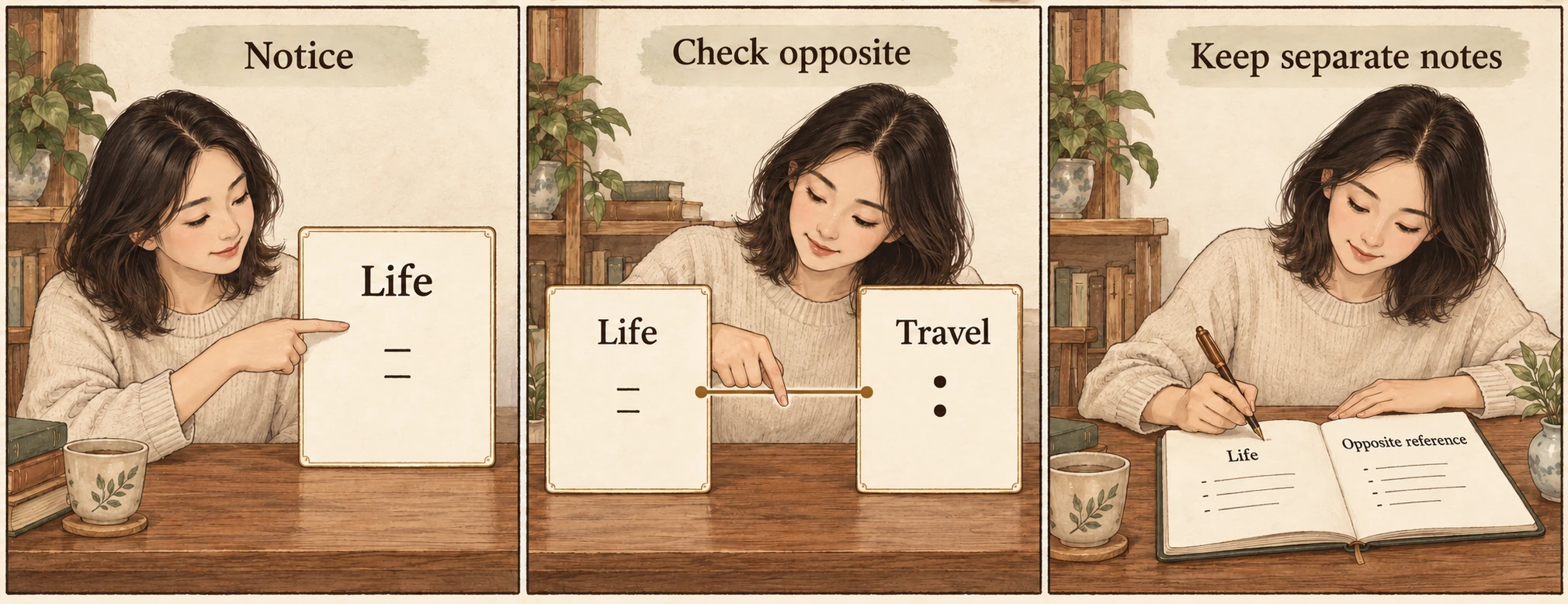
Keep both palace names in your notes. “No major star in Life; look at the stars in Travel” is a clearer starting point than silently treating those stars as if they were seated in Life. It preserves the distinction you are trying to understand.
Schools differ in how much emphasis they place on borrowed stars and how they combine them with local placements. Keep to one clearly explained method while learning. You do not need to assign a borrowed star a numerical strength to understand which palace it comes from.
A four-step way to organize your reading
1. Name the palace and its question
Write down the palace name before looking up any star meanings. Are you studying Life, Career, Spouse, or another part of the chart? Then write one question you want to understand. Keeping the topic narrow helps prevent every description from turning into a claim about your entire life.
2. Record the main stars across from it
Locate the opposite palace and note its major stars exactly as the chart labels them. Keep the Chinese name or pinyin when possible. English translations differ between sources, so two unfamiliar English labels may refer to the same star.
Do not select the description you like best and stop there. You are building a record of the chart before deciding what the symbolism suggests.
3. Add what is actually in the original palace
Return to the empty palace. Note its auxiliary stars and any other relevant labels your source explains. Keep these local placements separate from the major stars you are referencing across the chart. An organized list makes it easier to see whether a reading has skipped something or combined unlike pieces of information.
4. Read the connected palaces together
The opposite palace is one connection within a wider reading frame. San Fang Si Zheng considers the target palace, its opposite, and two trine-related palaces. When Life is the starting point, the four-palace group includes Life, Wealth, Career, and Travel.
You do not need to master the whole method in one sitting. Start by identifying those connections correctly. As you read, ask what each additional palace contributes. A useful explanation should make that relationship understandable rather than pile up star names.
What a clear reading note looks like
Suppose you have confirmed that the Life Palace in the chart you are studying has no major star. Your first line can simply read: “Life: no major star seated here.” Next, copy the actual star names from Travel onto a separate line headed “Opposite-palace reference.” Do not fill that line with a star from an online example.
Now add a third line for the smaller stars actually shown in Life. This little separation preserves the difference between a placement and a reading technique. When you later read an interpretation, you can check whether it used the original palace, the opposite palace, or both.
If you cannot identify the opposite palace confidently, stop before assigning meanings. Look for the palace names and the chart’s connection guide. In a circular layout, the opposite palace is six positions away around the twelve-position ring. In a square layout, visual proximity can be misleading; use the labels rather than the nearest box.
If your Life or Spouse Palace is empty
For an empty Life Palace, begin with the Life–Travel connection. Life concerns the self; Travel, also translated as Migration, concerns engagement with the world beyond the familiar setting. You can use that pairing to ask how the reading connects your sense of yourself with the situations you encounter outside your usual environment.
For an empty Spouse Palace, check the opposite Career Palace. This is a fixed structural pairing, not a claim that work must dominate your relationships. Ask how the interpretation distinguishes the relationship topic in the original palace from the stars it references across the chart. An empty Spouse Palace alone cannot establish whether you will marry.
Keep a distinction between three things: the placement you can point to, the interpretation a reader makes, and what you know from experience. “There is no major star here” belongs to the first category. “I avoid difficult conversations” would need support from your actual conversations.
Keep a small reading note
Before continuing, fill in these five lines:
- Palace I am looking at:
- Major stars in that palace, if any:
- Opposite palace and its major stars:
- Other labels and connected palaces to check:
- Question I still want the reading to explain:
This is a study aid, not a new calculation. It is especially helpful when an article uses one English translation and your chart uses another. You can return to the exact label instead of comparing two vague personality descriptions.
If you are also viewing decade or annual information, note that separately. Mixing a birth-chart placement with a label from a different time layer can make an explanation difficult to follow.
Bring a specific question to your YUVA reading
YUVA uses Zi Wei Dou Shu for Eastern birth-chart readings, with AI-assisted explanations for self-reflection. Its Chart, Reading, and Ask experiences serve different purposes: the chart supplies the underlying structure, the Reading interprets it, and Ask lets you follow up on your own Chart or Reading.
If the terms are new, start with YUVA’s introduction to Zi Wei Dou Shu. For the product workflow, see how the YUVA birth chart, Reading, and Ask fit together. A useful follow-up question is: “Which chart information supports this part of the reading, and how does the opposite palace contribute?”
Treat the interpretation as a prompt for reflection and compare it with your experience. An empty palace is a good place to practice careful reading: identify what is present, track where additional information comes from, and ask for the connection to be explained.
Common questions
Can an empty palace contain stars?
Yes. “Empty” commonly means no major star. Auxiliary stars may still be present.
Does borrowing a star change my chart?
No. It is a way of reading the relationship between palaces. The original placements stay the same.
Is this the same as an empty house in Western astrology?
The wording sounds similar, but the systems use different chart structures and reading rules. Zi Wei Dou Shu’s opposite-palace method should not be replaced with a Western house-ruler interpretation.
Should I change my birth time to get fewer empty palaces?
Use the most reliable birth information you have. Choosing a time to produce a preferred-looking chart changes the input; it does not resolve the question you started with.