
A YUVA birth chart reading can help you explore work and rest as different questions, rather than treating both as a test of how responsible you are. Start with a task you have already finished. Look at the work-related passage in your Reading, then distinguish what you accomplished, what you received from it, and how you felt afterward.
That distinction comes from the structure of the chart, not a zodiac stereotype. YUVA uses Zi Wei Dou Shu’s palaces and symbolic stars. Its life areas allow a reading about professional responsibility to be considered alongside material results and inner life, without assuming that success in one settles the others.
Three chart topics, three different questions
YUVA uses Calling & Work for the traditional Career palace. The traditional Wealth and Fortune palaces, labeled Money Rhythm and Inner Weather in YUVA, offer two other topics to keep in view. English labels can vary; use the traditional name and the explanation shown in your chart when comparing references. YUVA’s calculator guide explains its reading vocabulary, and the palace reference describes these domains.
| Chart topic | Question for a completed task | What belongs in your own notes |
|---|---|---|
| Career / Calling & Work | What role or responsibility did I take on? | The agreed work, your actual contribution, and whether the scope changed |
| Wealth / material resources | What tangible result did the work bring? | The actual compensation or resources involved, rather than a predicted reward |
| Inner Weather / Fortune, Fude Gong | What was the experience of living with that result? | Satisfaction, enjoyment, and whether there was room for life outside the task |
This is an original reading worksheet, not a scoring system or a chart result. A palace heading identifies a topic; it does not tell us which stars are in your chart or whether you feel fulfilled. Do not treat the third row as a medical assessment, or the second as a forecast of your income.
The useful contrast is simple: “I delivered the work,” “I received the reward I expected,” and “I feel satisfied” are three different statements. Your answers can differ without making the achievement meaningless.
Start with what your own chart and Reading actually show
Open your Chart and identify Calling & Work. Note the major stars displayed there and any relevant explanation you are using. In your Reading, find a passage that discusses work, responsibility, persistence, or contribution. Keep the chart context with the passage rather than turning one word into a fixed identity.
For example, YUVA calls Tian Liang The Guardian, with protection and perspective among its interpretive themes. The calculator guide uses that vocabulary to illustrate the difference between offering guidance and taking over. It does not follow that everyone who overcommits has Tian Liang, or that one placement causes the behavior.
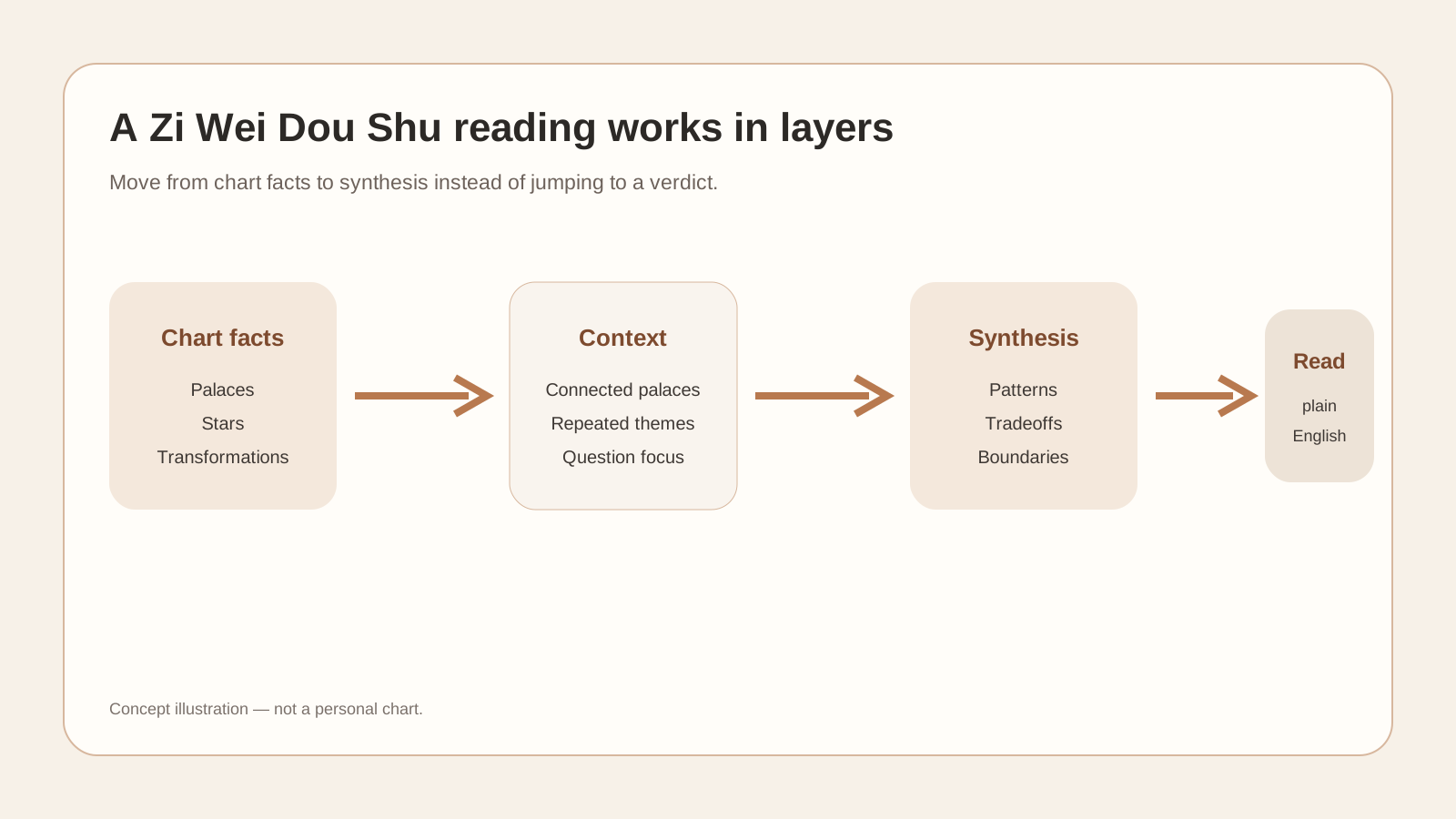
A fuller interpretation considers the surrounding configuration. The connected-palace guide explains why the chart is not a set of independent boxes. Here, you are using the three topic headings to organize your question; you are not assuming that Career, Wealth, and Well-being form one named three-palace configuration.
Follow one finished proposal through the three questions
The following is a fictional teaching scenario, not a customer’s story or a generated YUVA result. Morgan agreed to prepare a proposal that answered a question, explained the costs, and identified a decision needed by Friday. Those pieces are complete. Morgan keeps polishing the document anyway.
The work question is whether the agreed task is done. The tangible-result question is what was actually promised in return, if anything. The inner-life question is what makes stopping difficult. More editing may improve a particular sentence, but it may not answer the larger wish to feel useful.
Now change one fact. Suppose the decision-maker has not yet explained what the proposal must answer. Continued work may reflect an unresolved brief rather than a personal tendency to overdo things. The same late evening can have different explanations. Your actual circumstances belong beside the chart, not underneath it.
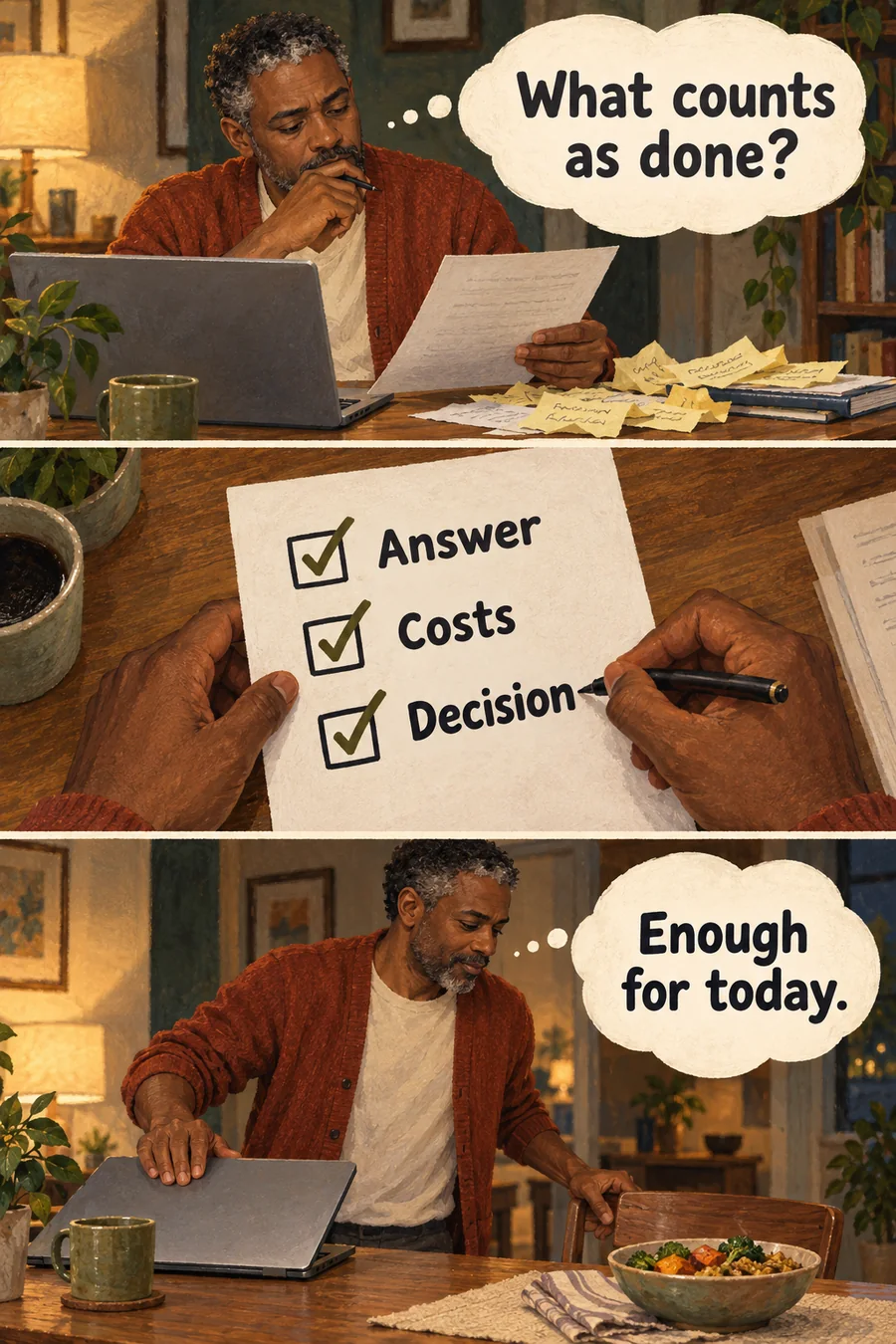
Put the comparison in your own notebook: what you agreed to deliver, what was complete, what you kept doing, and what you hoped that extra work would settle. None of those answers requires you to invent a star placement.
Use the Steward sample without making it your identity
The public YUVA walkthrough contains a fictional Steward Reading about reliability and limits. It is useful here because it demonstrates a distinction a reading can invite: being dependable does not require taking every new responsibility as your own.
In Morgan’s situation, that idea might lead to a question about the boundary of the proposal. In another situation, the same idea might be irrelevant because a specific agreed task is still unfinished. The sample is not a reason to stop work indiscriminately, and recognizing its language does not identify your Core Star.
With your own Reading, ask what the actual passage adds. Does it distinguish accepting a role from defining its limits? Does it address enjoyment separately from public contribution? An explanation that simply repeats “you are hardworking” has not yet clarified the question.
Take the unresolved part to Ask
YUVA’s Ask can continue from your own Chart or Reading with your situation as context. Choose one question rather than asking it to decide your career. An example is:
“I completed the proposal we agreed on, but kept editing because stopping felt like letting the team down. Help me explore the relevant responsibility themes in my Chart or Reading. How does the interpretation distinguish fulfilling a commitment from taking on more after it is complete?”
This is an example prompt, not a promise about the response. Include an exception, such as a project you completed without difficulty stopping. Was the scope clearer? Was someone else responsible for the next step? An exception helps keep the discussion specific rather than turning “responsible” into an explanation of everything.
When the concern is recognition, specify whether you wanted acknowledgment, a chance to present, or a discussion about your role. When the concern is enjoyment, name the part of the work you miss. These are different follow-ups; the chart should not collapse them into a single idea of success.
Return to an agreement, not a verdict
After reading, revisit the task’s actual endpoint. You might clarify the remaining decision, ask who owns the next stage, or note that additional editing is a separate choice. These are ordinary possibilities to consider, not instructions delivered by a star.
A chart cannot establish fair compensation, diagnose exhaustion, or determine whether you should leave a job. Use the relevant facts and appropriate support for those decisions. The purpose of this exercise is narrower: to articulate which responsibility you accepted and which question remains unanswered.
New to the product? Use the YUVA first-session guide. A personal chart requires a known local birth time and verified birthplace. My Star is free without an account; your personal Free Reading is free after sign-in and uses 0 Credits. Ask has separate Credit rules; review the displayed maximum before sending. The public fictional sample is available before you provide birth details.
Explore your YUVA chart with one completed task in mind. Keep the agreement, the result, and your experience as separate notes. The reading is another perspective on those notes, not a replacement for them.
YUVA is for entertainment and self-reflection. The chart framework and examples here are not scientifically validated assessments, predictions, or professional advice.