Does Chinese astrology have a Rising sign? Not in the simple sense of a direct equivalent.
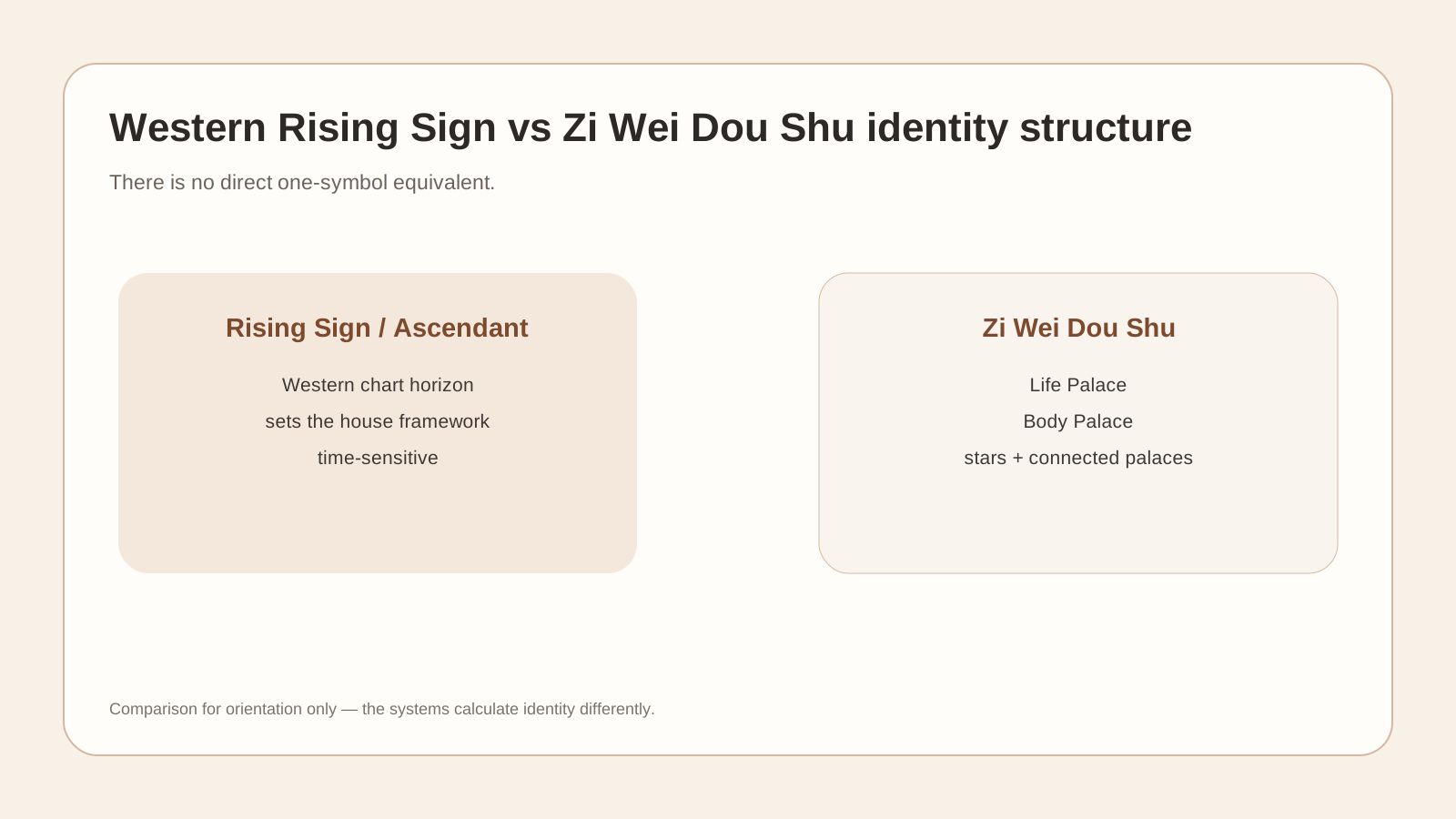
The Western Rising sign is the zodiac sign on the Ascendant, the point of the zodiac rising on the eastern horizon at the birth moment. Chinese astrology is a broad umbrella containing different systems, and those systems organize the birth moment differently.
In Zi Wei Dou Shu, there is no single symbol that should be translated as “the Chinese Rising sign.”
What is the Rising sign in Western astrology?
The Rising sign is the zodiac sign on the Ascendant, the eastern horizon point in a Western natal chart. It is highly time-sensitive and helps orient the house structure.
In modern interpretation, astrologers may associate it with approach, presentation, first impressions, embodiment, or the style through which the rest of the chart becomes visible.
Why there is no universal “Chinese Rising sign”
“Chinese astrology” does not refer to one single chart system. BaZi, Zi Wei Dou Shu, the year-animal zodiac, and other traditions use different calculations.
Trying to force a Western placement into a Chinese equivalent usually creates more confusion than clarity.
What plays an identity role in Zi Wei Dou Shu?
Zi Wei Dou Shu readers often begin identity-oriented interpretation with the Life Palace. The Body Palace adds another layer, and the major stars and connected palaces give the pattern context.
That can make the Life Palace feel superficially similar to a Western “identity placement,” but it is not the Ascendant. It is calculated and interpreted through a different system.
Read Life Palace and Body Palace in Zi Wei Dou Shu for more detail.
Does birth time matter in both systems?
Yes, although the mechanics differ.
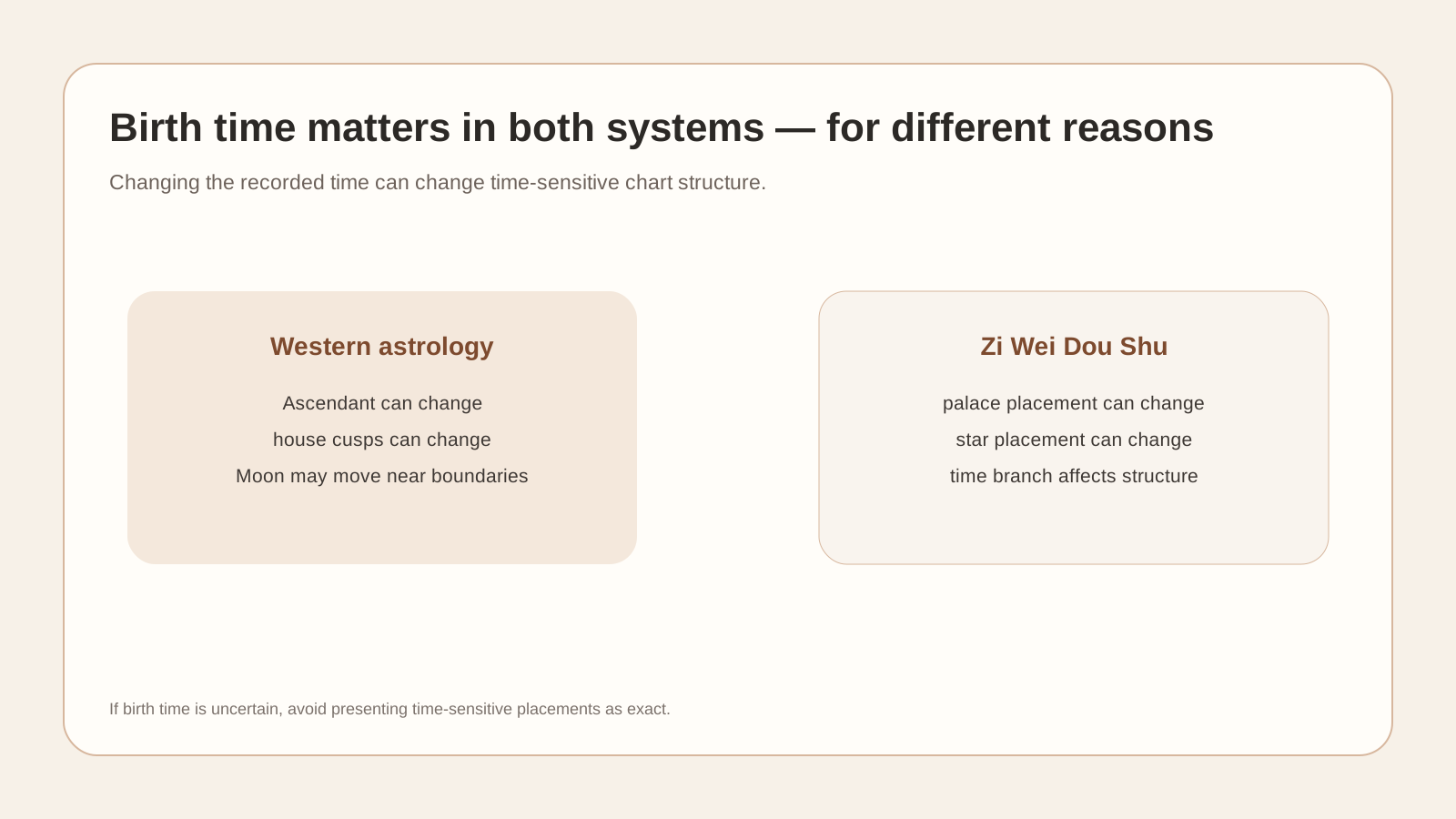
In Western astrology, birth time is central to the Ascendant and house cusps. In Zi Wei Dou Shu, the birth-hour branch is part of the chart construction and can affect palace and star placement.
This is why an unknown birth time should not be silently replaced with certainty.
What if you know your Rising sign and want an Eastern comparison?
Do not look for a star or palace with the same meaning. Instead, compare the questions each system helps you ask.
For example:
- Western: How does the Ascendant shape the way I enter situations?
- Zi Wei Dou Shu: What pattern emerges from my Life Palace, Body Palace, major stars, and connected palaces?
That preserves the integrity of both traditions.
What about BaZi?
BaZi also does not have a direct Western Ascendant equivalent. It uses the Four Pillars—year, month, day, and hour—along with stems, branches, Five Element relationships, and other derived structures.
See Chinese Astrology Birth Chart for the broader map of Chinese systems.
Frequently asked questions
Is the Life Palace the Chinese Rising sign?
No. It can play an important identity-oriented role in Zi Wei Dou Shu, but it is not calculated or interpreted as the Western Ascendant.
Does Chinese zodiac have a Rising sign?
The popular year-animal zodiac does not use a Western-style Ascendant. More detailed Chinese systems use other structures.
Can I compare my Rising sign with my Zi Wei Dou Shu chart?
Yes, as a comparison between two traditions. Avoid treating any palace or star as a direct equivalent.
Already know your Rising sign? Explore a different map of your birth moment →
YUVA presents astrology and metaphysical traditions for reflection and self-understanding. They are not scientifically validated methods for predicting future events.