
The Body Palace, or Shen Gong (身宮), is an additional reference point in a Zi Wei Dou Shu chart. It shares a position with one of the twelve palaces. The Life Palace, Ming Gong (命宮), is traditionally read for a person’s underlying disposition; the Body Palace adds a perspective on development, experience, and where effort takes shape.
That distinction explains why you can find “Body” written inside a box that already says “Career” or “Spouse.” Both labels belong there. To understand the placement, keep the original palace’s topic and the Body designation in view together.
Why the Body Palace shares a box
A Zi Wei Dou Shu chart has twelve positions around its outer ring. The twelve life-domain palaces occupy those positions, and the Body Palace is an overlay rather than a thirteenth box. Its location is calculated from birth information; you do not choose it according to the part of life that currently feels most important.
In the standard month-and-hour placement method, Body shares one of six palaces: Life, Spouse, Wealth, Travel, Career, or Fortune and Virtue. You may see different English names, such as Migration for Travel or Happiness for Fortune and Virtue. The Chinese label and the chart’s legend can help you match them.
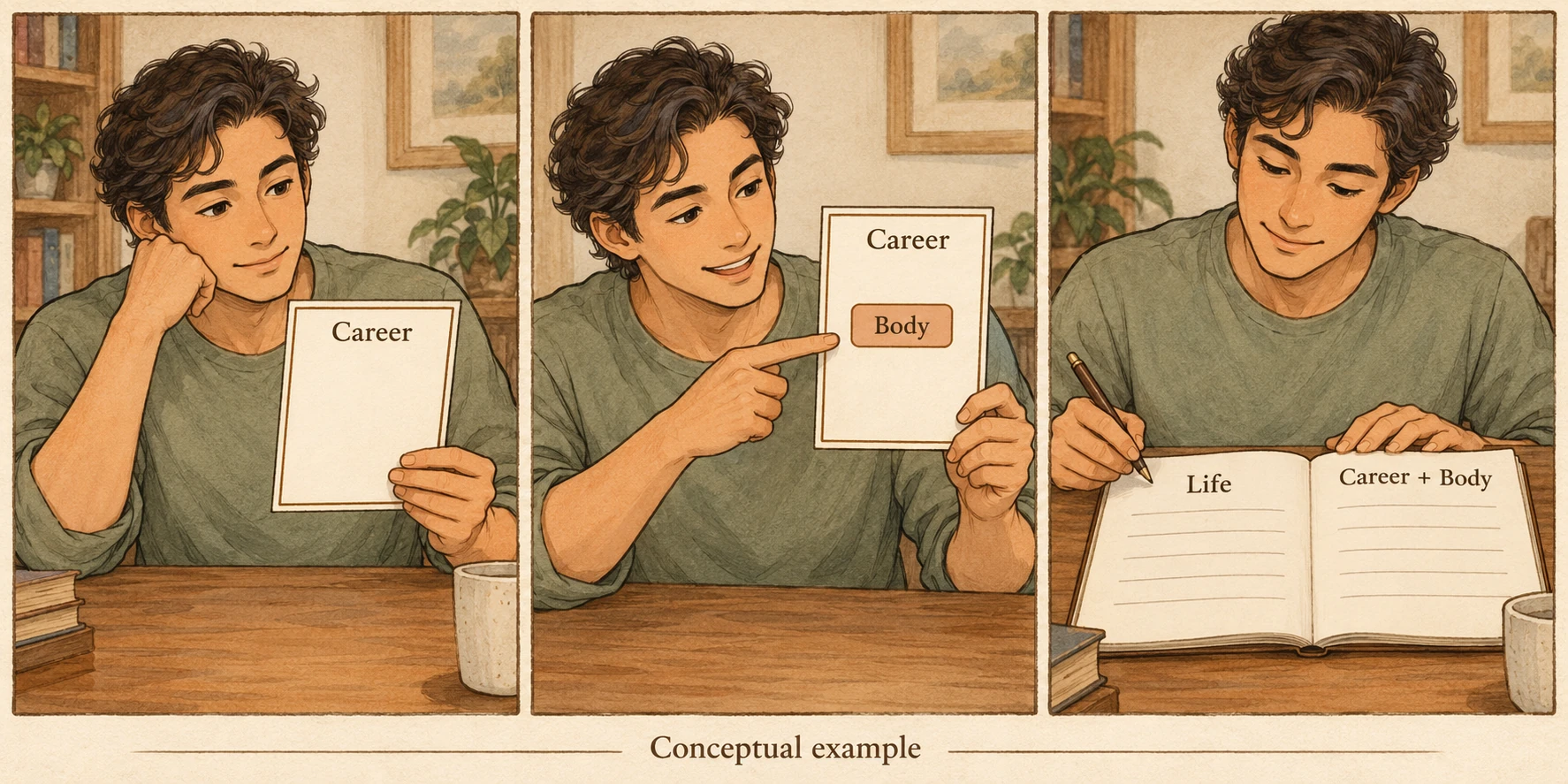
For a simple conceptual example, a box labeled “Career” can also carry “Body.” Career remains the life topic of that box. The second label tells the reader to consider it as the Body reference point as well. This example shows how the labels work; it does not assign a placement to you.
Life Palace and Body Palace answer different questions
Traditional explanations often describe Ming as what a person begins with and Shen as what develops through living. Some use the terms “pre-heaven” and “post-heaven.” These are terms within the tradition, not a scientific separation of inherited and learned personality.
For reading purposes, you can keep two questions beside your chart:
- Life Palace: What recurring disposition is this interpretation describing?
- Body Palace: How does the interpretation connect that disposition with experience, effort, or a particular life area?
The questions work best together. A description of your general approach becomes more useful when you can ask where it appears in practice. Likewise, a statement about work or relationships needs more context than the presence of the Body label alone.
What the six possible locations invite you to examine
The host palace supplies the topic. The prompts below are ways to reflect on that topic after checking the placement. They are not six personality diagnoses or predictions.
- Life, Ming Gong (命宮): Notice the relationship between how you describe yourself and how you actually behave. Which descriptions fit across different settings, and which depend on the situation?
- Spouse, Fu Qi Gong (夫妻宮): Look at the attention you give to close partnership. What do you learn through making agreements, expressing needs, and sharing decisions?
- Wealth, Cai Bo Gong (財帛宮): Consider how you handle resources and the work involved in supporting daily life. What does “enough” mean in your actual circumstances?
- Travel, Qian Yi Gong (遷移宮): Examine your experience in unfamiliar environments and interactions outside your usual circle. What changes when the setting changes?
- Career, Guan Lu Gong (官祿宮): Reflect on the effort you put into work, responsibilities, and contribution. Which parts are chosen, and which have become habits?
- Fortune and Virtue, Fu De Gong (福德宮): Consider inner satisfaction, enjoyment, and the space you make for them. What feels restorative in practice?
You do not need to force a major event into any of these topics. A useful observation might be as ordinary as noticing that you approach decisions differently at work and at home. Record what you can actually observe before deciding whether the symbolism helps describe it.
Read the two reference points in four steps
1. Locate the labels before interpreting them
Find Ming Gong or Life, then look for Shen Gong or Body. Write down which palace carries the Body marker. If your view does not show it, check the legend or available chart details; a missing display label does not establish that the underlying chart has no Body Palace.
Keep the birth-chart layer separate from any annual or decade information you are also viewing. A palace name in a time-specific layer can make a screenshot harder to read if you do not know which layer is active.
2. Record what is actually in each location
Copy the major-star names and relevant labels from Life and from the palace hosting Body. Keep these as two clearly headed notes, even when both references share a box. Use the same pinyin or Chinese spelling as your chart so you can look up an unfamiliar name accurately.
The Body marker does not add a new set of stars to its host palace. You are asking how the existing placements are read with that additional reference point.
3. Keep the host palace’s topic in the explanation
A clear reading should connect its claim to the appropriate topic. If the Body marker is in Career, for example, ask how the interpretation reaches a statement about work or responsibility. If it immediately turns that label into a verdict about your entire personality, important steps may have been skipped.
This is also a good moment to notice your own assumptions. “Career is emphasized here” does not establish which occupation you should choose. The chart topic and a real-world decision are different levels of the conversation.
4. Compare the reading with a specific experience
Choose one recent situation rather than trying to summarize your whole life. Write what happened, how you responded, and what you would like to understand. Then compare that account with the interpretation. A mismatch is useful information; you do not need to rewrite your experience to fit the label.
Your note can end with a concrete question: “Which part of this reading comes from Life, which comes from the Body placement, and how are you combining them?” That is easier to answer than “Which palace is the real me?”
Does the Body Palace take over after age 30?
You may encounter that claim in beginner explanations. Some teaching traditions emphasize Body more in later life, but they do not all use the same age or give it the same weight. Treat a fixed birthday cutoff as a particular teaching convention, not a universal switch that turns the Life Palace off.
For a first reading, learn how your chosen source relates the two reference points. There is little benefit in combining an age rule from one teacher with a star interpretation from another without understanding either method.
Three labels that are easy to confuse
- Shen Gong, 身宮, the Body Palace: the overlay discussed in this guide.
- Shen, 申, an Earthly Branch: one of the twelve position labels. It is a different Chinese word, despite similar English spelling.
- Body ruler or Shen Zhu, 身主: a designated star reference in some chart traditions. A star named as Body ruler is not automatically a star seated in the Body Palace.
Also, “Body” in this term should not lead you to treat the marker as a medical assessment. Zi Wei Dou Shu has a separate Health or Illness Palace; neither label can diagnose a health condition.
Use the distinction in a YUVA reading
YUVA’s Zi Wei Dou Shu guide introduces the symbolic stars and palaces behind its Eastern birth-chart readings. If you are learning the terminology alongside your reading, keep the palace name and the experience you want to discuss together.
YUVA describes Ask as a follow-up conversation grounded in your own Chart or Reading. You might ask: “This reading emphasizes work. Which chart information supports that interpretation, and how should I compare it with my experience?” See the explanation of Chart, Reading, and Ask for how those parts fit together.
The useful outcome is a clearer explanation you can evaluate. You remain free to disagree with it, add context, or decide that another question matters more.
Common questions
Can Life and Body be in the same palace?
Yes. Both labels can occupy the same position. That means the reader considers the same local placements through both reference points; it does not give a simple “better” or “worse” chart rating.
Does everyone have a Body Palace?
A completed chart using the standard method includes a Body position. Chart displays and reading styles differ in how prominently they show or use it.
Is Body the same as a Western rising sign?
No. These belong to different calculation and interpretation systems. Familiarity with a rising sign can help you recognize the idea of multiple chart reference points, but it does not supply Shen Gong’s rules.