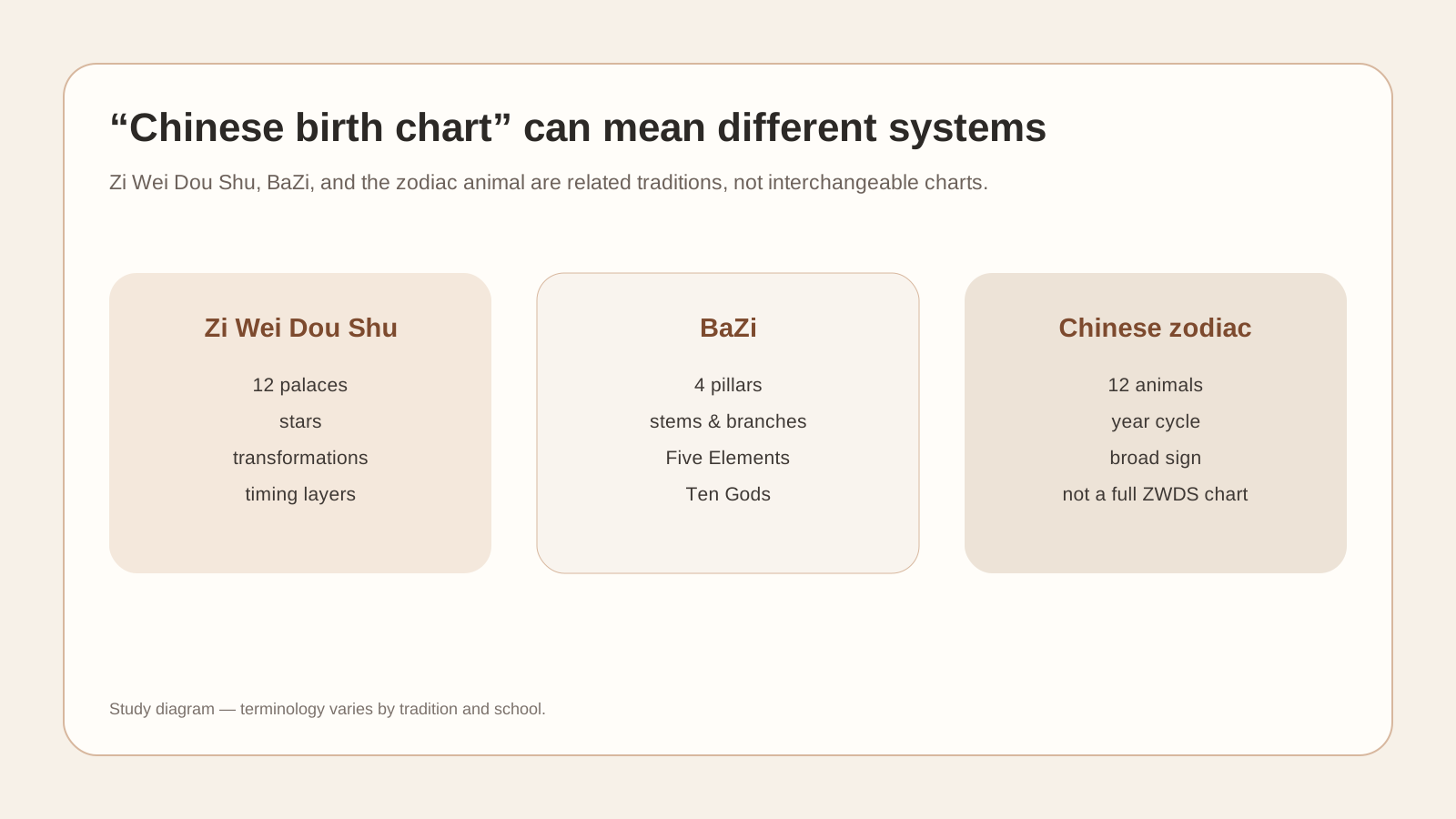
A Chinese birth chart is a chart calculated from birth details within a Chinese astrology tradition. Two major systems are Zi Wei Dou Shu, which uses a twelve-palace star chart, and BaZi, which uses the Four Pillars. A Chinese zodiac animal based on birth year is a broader classification, not a full birth chart.
Want to create your chart? Open the YUVA Birth Chart calculator →. YUVA generates a Zi Wei Dou Shu chart, not a BaZi chart, with English labels.
Have your birth date, known local birth time including hour and minute, gender and birthplace ready. Sign in to generate your chart and a free personal Reading (0 Credits). Generation limits apply.
Zi Wei Dou Shu, BaZi or the Chinese zodiac?
These systems belong to the wider Chinese metaphysical tradition, but they organize birth information differently. Identify the system before applying its reading rules.
1. Zi Wei Dou Shu: a twelve-palace star chart
Zi Wei Dou Shu, often translated as Purple Star Astrology, organizes a chart into twelve palaces representing areas such as identity, relationships, career, wealth, family and social connections. Major and supporting stars occupy the palaces according to the calculation.
A reading considers the stars together with connected palaces, the Four Transformations and timing layers. For a practical introduction, see how to interpret a Zi Wei Dou Shu chart.
2. BaZi: the Four Pillars
BaZi represents the birth moment with four pillars: year, month, day and hour. Each contains a Heavenly Stem and an Earthly Branch, making the “eight characters” that give BaZi its name.
Its reading framework includes the Day Master, Five Elements, Ten Gods, combinations, clashes, seasonal strength and luck periods. These are not alternative names for Zi Wei Dou Shu stars or palaces.
3. The Chinese zodiac animal: a broader classification
The year-based zodiac animal, such as Dragon, Snake or Horse, is the most familiar form of Chinese astrology in popular culture. Many people share the same animal; a full Zi Wei Dou Shu or BaZi chart uses more of the birth moment to create a more detailed symbolic structure.
Same birth information, different maps
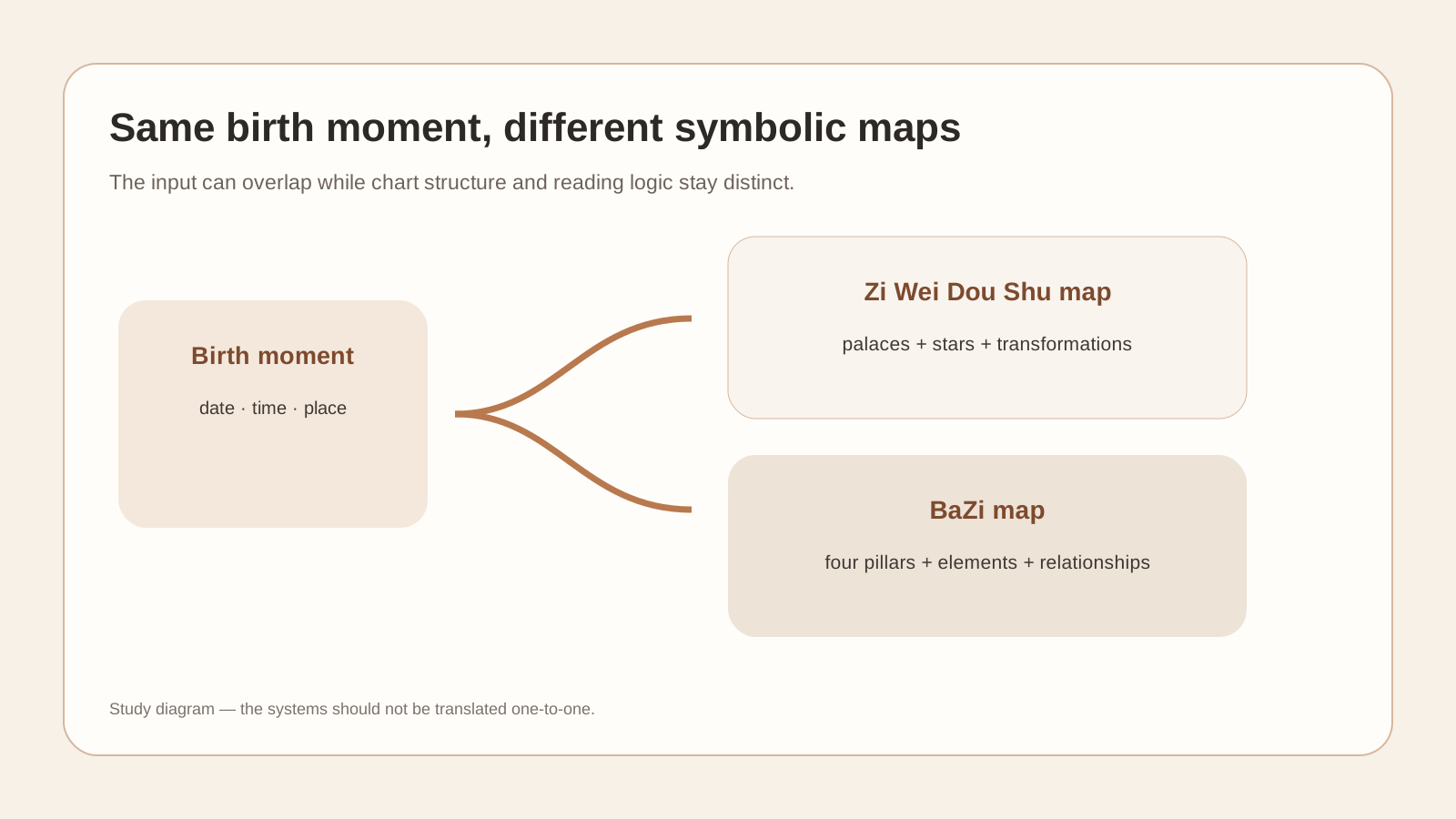
A Zi Wei Dou Shu palace is not a BaZi pillar, and a Zi Wei Dou Shu star is not a BaZi Ten God. Similar themes do not make their symbols interchangeable. For a side-by-side explanation, read Zi Wei Dou Shu vs BaZi.
What do you need to calculate your chart?
Inputs vary by system and calculator. For YUVA’s Zi Wei Dou Shu calculator, prepare:
- Birth date: year, month and day.
- Known local birth time: hour and minute, rather than an invented placeholder.
- Gender: the input used by the traditional calculation.
- Birthplace: select where you were born from the suggestions, not your current home. The selected place supplies the location and time-zone information.
If you do not know your birth time, check your birth or hospital records first. YUVA requires a known hour and minute; it does not guess a missing time or substitute noon.
A small, calculated Chinese birth chart example
This fictional example was calculated by YUVA using March 20, 1995, at 8:00 a.m. local time, Shanghai, China, male. The effective calculation time was 7:58 a.m. The full result has twelve palaces and fourteen major stars; these three rows show a small part of it.
| Traditional palace | YUVA label | Calculated major stars |
|---|---|---|
| Life Palace (命宫) | Self Pattern | Tian Fu 天府 — The Steward (Bright) |
| Career Palace (官禄宫) | Calling & Work | Tian Xiang 天相 — The Diplomat (Veiled) |
| Travel Palace (迁移宫) | Outer World Pattern | Zi Wei 紫微 — The Sovereign (Bright); Qi Sha 七杀 — The Vanguard (Steady) |
Start by locating the Life Palace, then read it alongside its connected palaces rather than treating Tian Fu as a complete personality description. The names and expression labels above are calculated chart fields. See the full fictional example and reading walkthrough for the remaining palaces and transformations.
Which Chinese birth chart should you choose?
Choose a framework you want to learn, rather than assuming one chart can answer every question.
- Choose Zi Wei Dou Shu if you prefer a visual map of life areas and want to study stars, their combinations and connected palaces.
- Choose BaZi if you want to explore the Day Master, stems and branches, Five Element relationships and luck pillars.
- Use a zodiac animal for a quick cultural reference, without treating it as a full natal chart.
Is Chinese astrology the same as Western astrology?
No. Western natal astrology usually uses planets, zodiac signs, houses and aspects. Zi Wei Dou Shu and BaZi use different symbolic structures and calendrical rules. All can be called “birth charts” in English, but they do not calculate the same thing.
What will YUVA give you?
YUVA presents a calculated Zi Wei Dou Shu chart with English labels, followed by AI-assisted Reading and Ask experiences grounded in that chart. Calculation produces the chart structure; interpretation explains its traditional symbolism.
You can fill in your details before signing in, but creating your personal chart and Reading requires sign-in. A new personal Reading costs 0 Credits, with generation limits. Ask is a separate Credit-based experience. For the product walkthrough, see YUVA Birth Chart Calculator: Your Chart and What It Means.
Choose the next guide for your question
- How do the full systems differ? Read the BaZi and Zi Wei Dou Shu comparison.
- How do I create one? Use the calculator guide and its fictional, calculated example.
- How do I read the chart? Follow the step-by-step twelve-palace reading guide; its rules apply to Zi Wei Dou Shu.
- What might it add to a relationship question? Start with the one-person relationship-patterns guide, then distinguish it from a two-chart comparison.
- What might it add to a work question? Try the work, rest and responsibility guide without treating a chart as a job recommendation.
Frequently asked questions
What is the most detailed Chinese birth chart?
There is no single objectively “most detailed” system. Zi Wei Dou Shu and BaZi are both sophisticated traditions with different structures and schools of interpretation.
Is the Chinese zodiac animal a birth chart?
It is a broad birth-year classification, but it is much simpler than a full Zi Wei Dou Shu or BaZi natal chart.
Is Zi Wei Dou Shu Chinese astrology?
Yes. Zi Wei Dou Shu is one Chinese natal astrology tradition, often called Purple Star Astrology in English.
Can I use both BaZi and Zi Wei Dou Shu?
Yes, but read them as separate systems first. Do not silently transfer rules or symbols from one framework to the other.
Create your YUVA Birth Chart →
YUVA presents astrology and metaphysical traditions for reflection and self-understanding. They are not scientifically validated methods for predicting future events.