Zi Wei Dou Shu AI can be useful for translating a dense Purple Star Astrology chart into clearer language, comparing repeated themes, and answering focused questions. But the quality of the result depends on one thing that is easy to miss: the AI needs the actual chart structure first.
If you give a model only your birthday and ask, “What is my destiny?”, it may produce fluent text without a reliable Zi Wei Dou Shu calculation behind it. A better system separates chart calculation from AI interpretation.
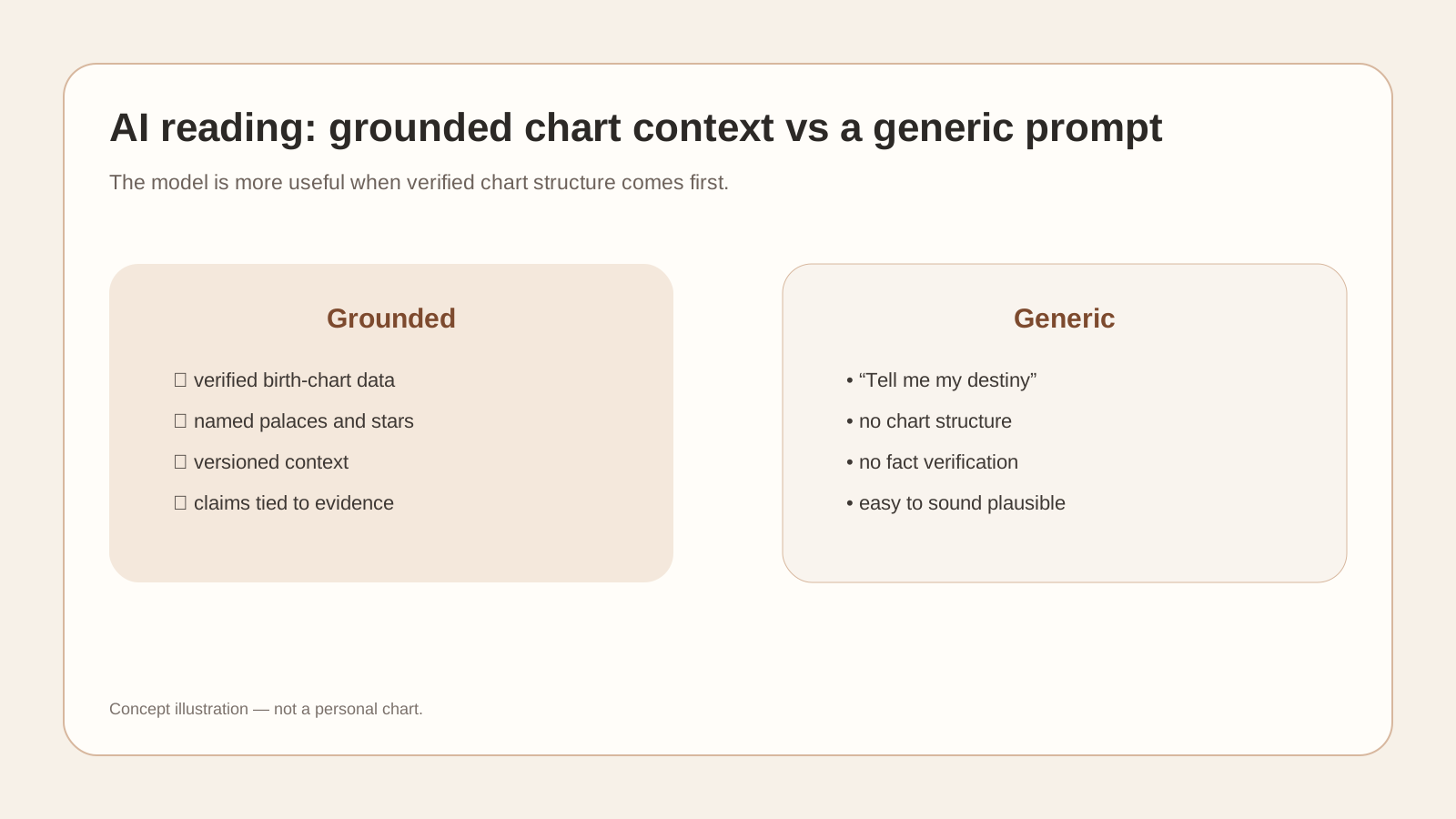
What can AI actually do with a Zi Wei Dou Shu chart?
AI is well suited to language-heavy parts of the experience. Once a chart has been calculated, it can help:
- explain unfamiliar star and palace terms in plain English;
- compare several chart factors without forcing the user to memorize them;
- find repeated themes across palaces;
- turn technical chart structure into readable observations;
- answer a focused follow-up question using the chart as context;
- keep a long interpretation organized.
These are synthesis tasks. They are different from calculating the chart itself.
The first rule: do not let the language model invent the chart
A Zi Wei Dou Shu chart is produced by a calculation system. The AI explanation should consume those results rather than improvise them.
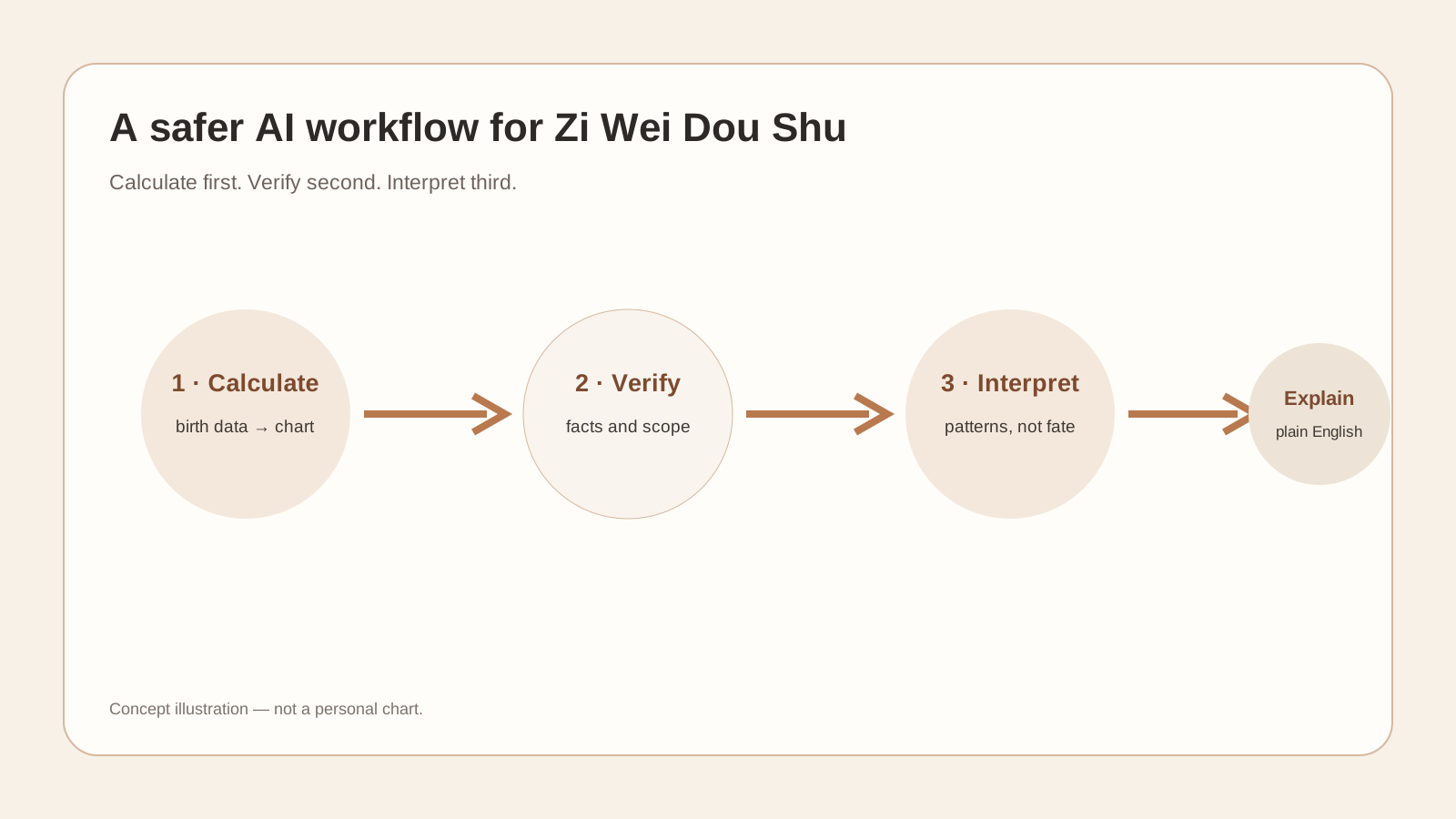
A grounded workflow looks like this:
- collect the birth information;
- calculate the chart with a deterministic chart engine;
- store the relevant palaces, stars, transformations, timing layers, and source version;
- give that structured context to the language model;
- ask the model to explain only what the available chart data supports.
If you skip steps two through four, the AI can easily produce a plausible but unsupported reading.
Why generic AI readings can sound convincing
Large language models are good at producing coherent prose. That strength can become a weakness when the underlying data is missing.
A generic response may use:
- broad personality statements that fit many people;
- well-known astrology language without chart-specific support;
- rules copied from a different Chinese metaphysical system;
- invented star placements or palace relationships;
- confident timing claims that were never calculated.
The result can feel personal because the prose is smooth, not because the chart evidence is strong.
How to tell whether an AI reading is grounded
Ask a few simple questions:
- Can the system show the chart it is reading?
- Can you see the palace and star behind an important observation?
- Does the answer distinguish natal structure from timing layers?
- Can the system say when the available chart data does not justify a specific conclusion?
- Does it keep Zi Wei Dou Shu rules separate from BaZi or Western astrology unless it explicitly compares them?
A grounded reading should be inspectable. You should not have to trust the prose blindly.
AI is better at synthesis than fortune-cookie output
The most useful role for AI is not “tell me one sentence about who I am.” It is combining several pieces of chart context without losing the relationships between them.
For example, suppose a work-related pattern appears in the Career palace, is reinforced by a connected palace, and is modified by a transformation. An AI system can help turn that structure into a readable observation and then suggest a question to test against real life.
That is more useful than simply saying, “You are ambitious.”
What about AI and timing predictions?
Timing is where overconfidence becomes especially risky. If a system supports decade, annual, monthly, or daily layers, those layers should be calculated explicitly and tied to a date or period.
The AI should not infer a detailed timing chart merely because the user asks, “Is tonight lucky?” or “Will I get married this year?”
A better answer distinguishes:
- what the natal chart says;
- which timing layer is actually available;
- what changes in that period;
- what remains uncertain;
- which real-world outcome cannot be guaranteed by the chart.
What makes an AI birth-chart product more trustworthy?
Inside an interpretive tradition like Zi Wei Dou Shu, good product design is less about making stronger claims and more about preserving provenance.
Useful signals include:
- a visible chart rather than hidden inputs;
- a deterministic calculation layer;
- versioned chart or knowledge data;
- clear separation between calculation and generated prose;
- bounded interpretations when data is incomplete;
- the ability to revisit the same chart and reproduce the context used for an answer.
If you want to understand the chart before adding AI, start with the Zi Wei Dou Shu calculator guide and what a good reading should explain.
How YUVA uses AI
YUVA is designed around a chart-first approach. The chart structure is calculated and displayed, then Reading and Ask use that chart context for explanation. The goal is to keep the model from becoming the source of chart facts.
This also makes the experience easier to debug: if an explanation feels wrong, the user can inspect the chart, the relevant palace or star, and the question being asked instead of treating the answer as an opaque prediction.
Can ChatGPT read Zi Wei Dou Shu?
A general-purpose model can discuss Zi Wei Dou Shu concepts and can help interpret a chart that you provide. But it should not be assumed to have calculated a correct chart merely because it knows your birth date. The safer route is to calculate the chart first and then give the model the structured result.
Frequently asked questions
Is AI better than a human Zi Wei Dou Shu reader?
They have different strengths. AI can organize large amounts of chart context and explain it consistently. A skilled human reader may bring a deeper school-specific tradition and judgment. Neither should be treated as scientifically validated prediction.
Can AI calculate my Zi Wei Dou Shu chart?
An AI product can call a chart-calculation engine, but the language model itself should not be trusted to improvise exact placements from memory.
Why do two AI readings disagree?
They may be using different chart inputs, different calculation rules, different knowledge sources, or different prompts. A system that exposes its chart context makes those differences easier to diagnose.
What is the best prompt for a Zi Wei Dou Shu AI reading?
Use a specific question and provide verified chart data. Ask the model to identify the evidence behind each major observation and to separate strong support from tentative interpretation.
Explore your YUVA chart →
Start with the calculated chart, then use AI to explore the patterns.
YUVA presents astrology and metaphysical traditions for reflection and self-understanding. They are not scientifically validated methods for predicting future events.