
To read your birth chart in YUVA, begin with My Star, explore one life area in the wider Chart, and use Reading or Ask when you want to understand how the pieces connect. You do not need to learn every traditional star name before starting. You do need to keep three things separate: what your chart contains, how the reading interprets it, and what you recognize in your life.
This is a guide to using YUVA’s Eastern birth chart, based on Zi Wei Dou Shu. It is not a tutorial for finding Western Sun, Moon, or rising signs. The aim of your first session is to understand one part of your own chart and leave with a more specific question, rather than a collection of personality labels.
Choose a sample or your own chart
When you want to inspect the writing first, open the public YUVA walkthrough and fictional Reading sample. No personal birth details are needed for that example. It demonstrates the experience; it is not a result calculated for you.
To create your own chart, use Discover My Star. Have your birth date, a known local birth time including hour and minute, and a verified birthplace selected from the location suggestions ready. Follow the form’s explanations for its calculation inputs. Do not insert noon or invent a minute to make an unknown time look certain. With only an estimate, check your records before continuing; the birth-time guide explains the distinction.
My Star is free without an account. Your personal Free Reading is also free (0 Credits), but you must sign in to prepare and save it. Ask is a separate experience that requires sign-in and can use Credits; check its displayed cost before sending. A question entered during intake remains an editable draft until you send it.
Read My Star as an introduction, not a whole identity
My Star introduces your Core Star. YUVA uses English reading names alongside the traditional vocabulary: for example, Tian Fu is called The Steward. The calculator guide explains these labels and the distinction between the preview and the wider chart.
Write down the name actually shown in your result and one phrase you want to understand. Do not borrow a star from an article because its description sounds appealing. Two people recognizing the same adjective does not make their charts identical, and a single star name does not explain every setting in your life.
Move from the preview to one life area
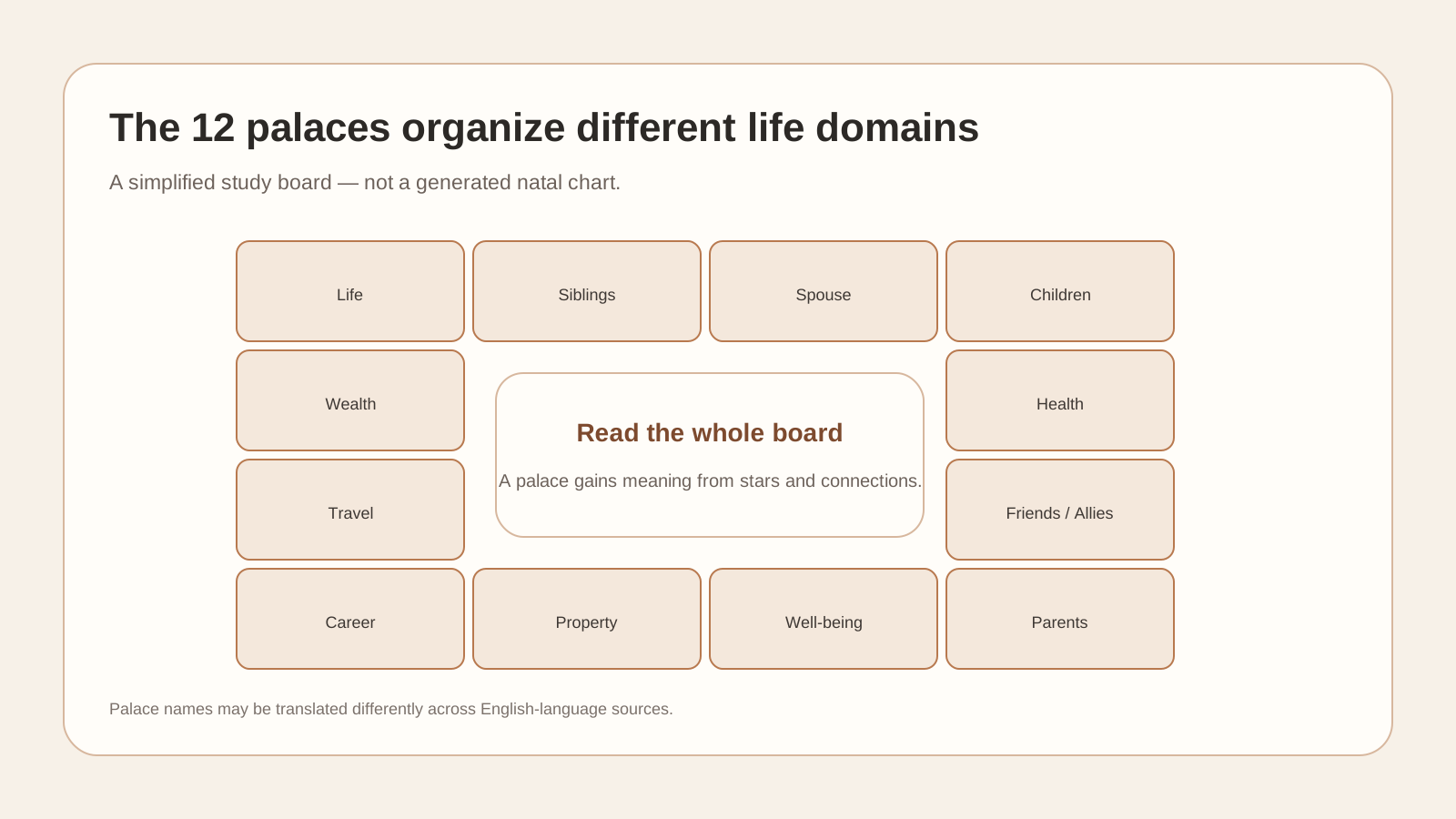
Explore the Chart’s twelve-palace map. A palace is a chart area associated with a life topic; it is not a separate personality type. Start with the topic that matches your question, using the labels displayed in your view.
| Your question | A YUVA topic to explore | What the heading does not establish |
|---|---|---|
| How do I tend to approach situations? | Self Pattern | A complete description of your identity |
| What happens when I take on responsibility? | Calling & Work | Which job you should choose |
| How do I participate in friendships or groups? | Community & Allies | What a particular friend secretly thinks |
These are starting topics, not promised findings. The twelve-palace reference explains the traditional domains. A personal interpretation also needs the stars and wider chart context; choosing a topic does not guarantee that every Reading will contain a passage about your exact situation.
Record what is there before deciding what it means
Make a short note of the palace name, the major stars actually displayed there, and any explanation or connected-palace information you are consulting. Keep traditional names beside English names when available so you can compare references without confusing labels.
A palace with no major star is not a missing area of life. Supporting stars and connected palaces may still matter. Likewise, a brightness label or transformation is part of the interpretive context, not a grade for your prospects. Look up an unfamiliar term when it affects your question; you can leave other terms for later.
For a first pass, a useful note might simply say, “I am looking at Calling & Work. The chart lists these stars. I do not yet understand this connection.” That is a better starting point than assigning a meaning to a symbol you have not identified.
Use Reading to connect the pieces
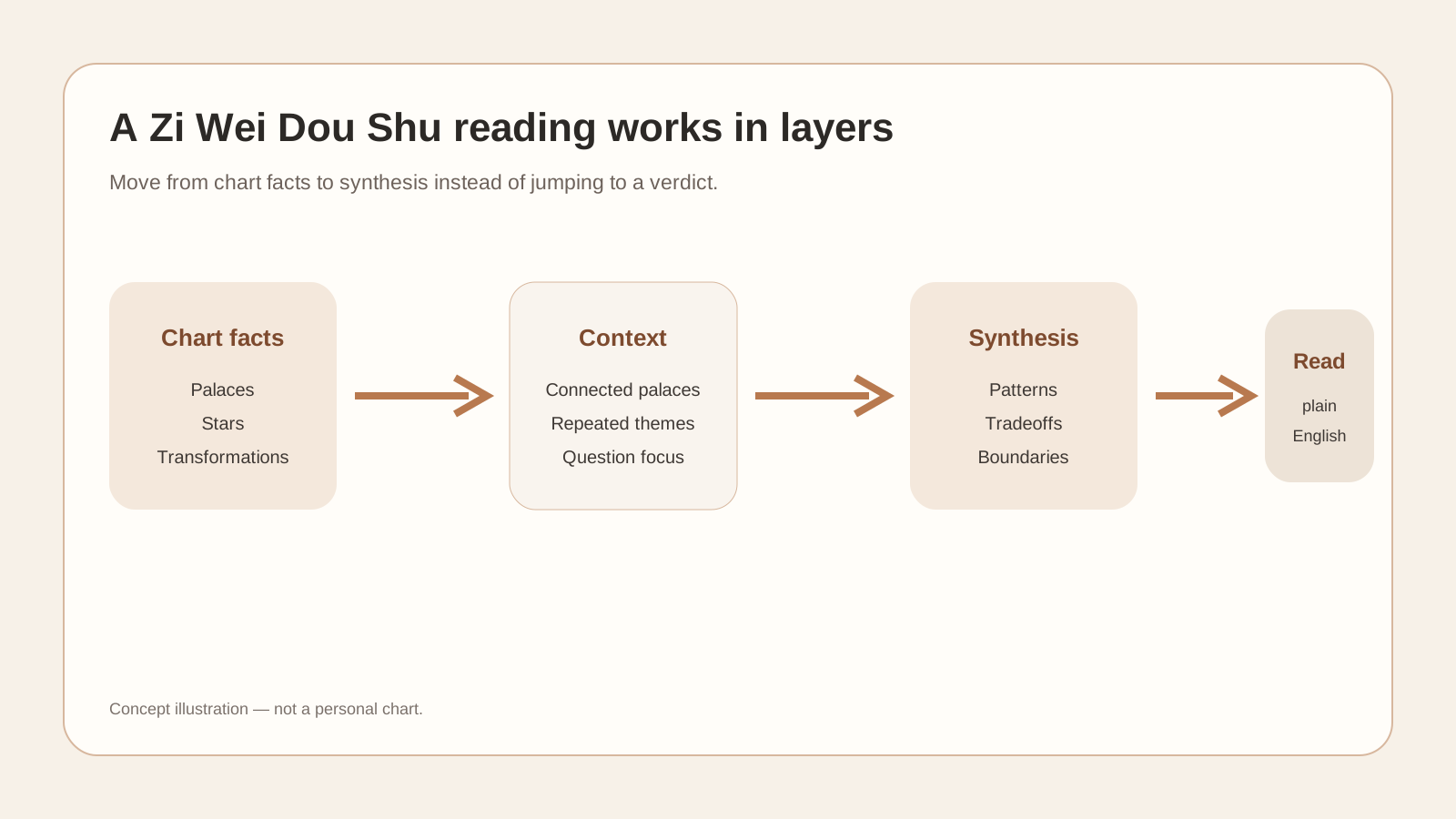
Chart is the calculated structure; Reading is its AI-assisted interpretation. A clear reading should let you understand which chart features it is discussing. If a passage seems useful, keep its explanation with it instead of copying only the most flattering sentence. Our guide to a useful Zi Wei Dou Shu reading explains what to look for.
The public Steward sample includes the line, Reliability can include a clear limit.
It is explicitly fictional. Here is one way to work with it without pretending it came from your own chart.
Imagine someone agreed to review a colleague’s proposal, then rewrote the entire document. The sentence raises a precise question: did being reliable mean completing the agreed review, or taking ownership of everything that could be improved? Compare that with an occasion when a small, clearly defined review was enough. This scenario is an original illustration, not a chart calculation or a YUVA-generated answer.
With your own Reading, choose a passage actually present in it. A sentence that does not fit your experience can remain a disagreement; you do not need to reinterpret your history to make it work.
Bring one passage and one situation to Ask
Ask can continue from your own Chart or Reading. Include the situation you want to discuss, what you did, and what remains unclear. You can use this example structure, replacing the details with your own:
“I agreed to review a proposal but ended up rewriting it. Help me explore the relevant work or responsibility themes in my Chart or Reading. Which parts of the explanation come from my chart, and what should I compare with the situation I described?”
This is a suggested question, not a guaranteed answer. Do not paste a fictional sample as though it were your result. If the response stays broad, ask it to clarify one passage rather than repeatedly requesting a complete new personality description. The AI reading guide covers the limits of an explanation that sounds confident.
Finish with something you can return to
Keep four short notes: the chart area you explored, one interpretation in your own words, a real example or exception, and the question you still have. These can stay in your own notebook; this exercise does not require a special worksheet feature in the app.
For a focused next session, try the work and rest guide or the friendship-patterns guide. To study the traditional method in greater depth, use the separate chart interpretation reference.
Begin your YUVA chart with one question in mind. You can stop after the free My Star preview, inspect the wider chart, or choose a Reading when you want more explanation.
YUVA is for entertainment and self-reflection. Chart symbolism is not a scientifically validated assessment or prediction, and it does not replace your judgment or appropriate professional advice.