
Your Sun, Moon, and Rising signs are three reference points in a Western birth chart. They do not translate into three equivalent labels in YUVA. To explore an Eastern birth chart, keep the same birth details but learn a different reading structure: stars placed in life palaces, interpreted with their connected context.
You do not need to discard the Big 3 you already know. The useful next step is to distinguish a calculated placement from the meaning attached to it. Below, one fictional birth moment produces an actual Western Big 3 and an actual YUVA chart, so you can see what changes before entering your own details.
What Sun, Moon, and Rising mean
The Sun sign is the sign occupied by the Sun at birth. Modern Western readings often associate it with identity, vitality, and purpose. The Moon sign is the Moon’s sign, commonly discussed through habits, comfort, and emotional responses. Cafe Astrology’s references on the Sun and the Moon describe those interpretive roles.
The Rising sign, or Ascendant sign, is the zodiac sign rising on the eastern horizon at the birth moment. Unlike a planet, it is a geometrical chart point determined by time and location. Modern readings often discuss it through approach and presentation, although its role extends beyond first impressions. A reliable birth time matters, as the Ascendant calculation guide explains.
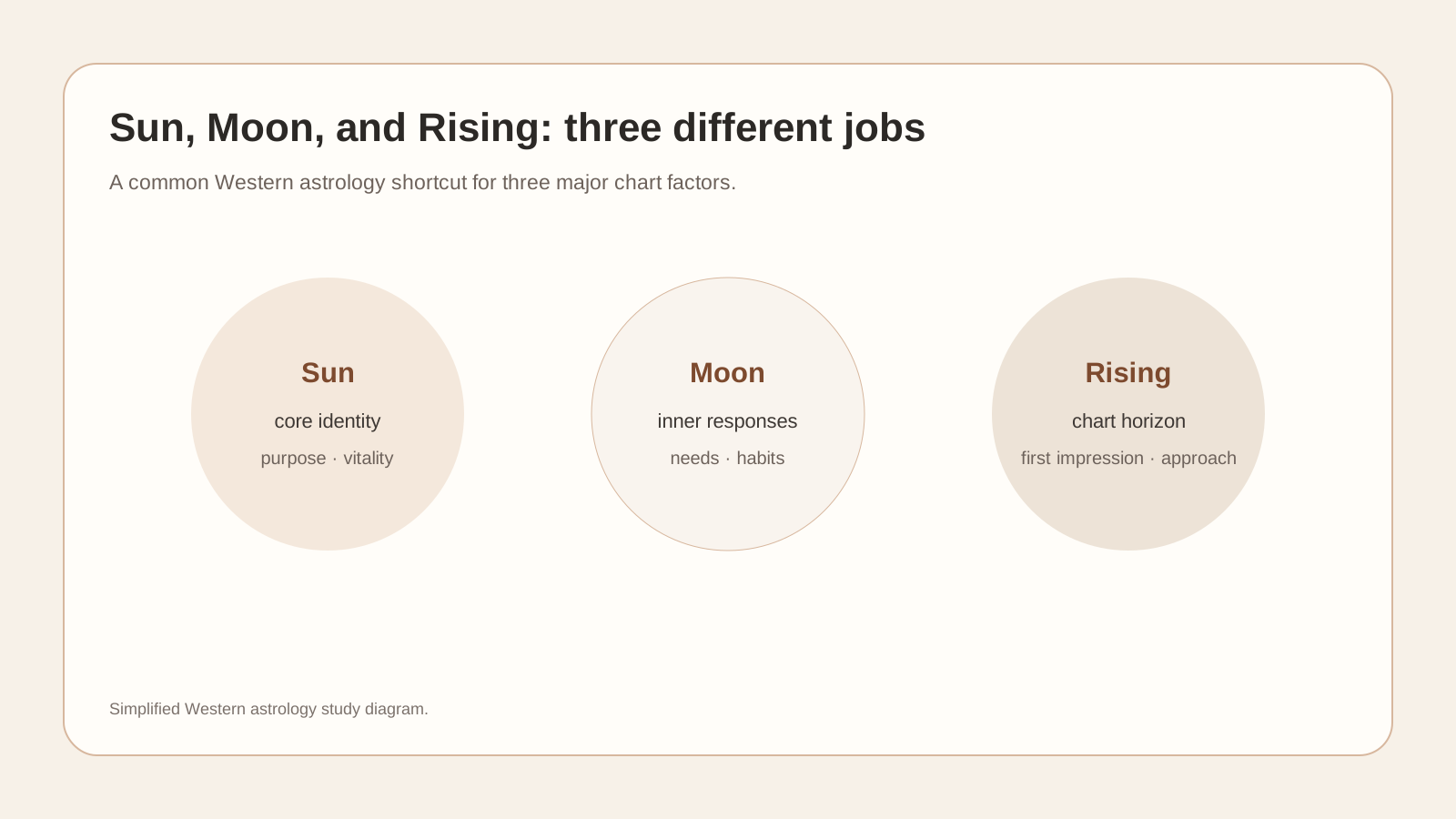
These short descriptions are starting conventions, not separate boxes into which every experience must fit. A full Western reading also considers houses, other planets, and aspects. YUVA is another chart tradition, not a claim that Western astrology stops after three signs.
One birth moment, two separately calculated outputs
The example uses fictional details: March 20, 1995, at 8:00 a.m. in Shanghai, China. For the Western chart, we calculated tropical positions at the corresponding 00:00 UTC. For YUVA, we entered the original local time, selected the verified Shanghai birthplace, and used the male calculation setting required by that example.
The Western calculation returned:
| Factor | Sign and degree within the sign | What the row records |
|---|---|---|
| Sun | 28.91° Pisces | The Sun’s tropical zodiac position |
| Moon | 7.86° Scorpio | The Moon’s tropical zodiac position |
| Ascendant | 10.19° Taurus | The calculated eastern-horizon point |
Those are calculation results, not an interpretation of a customer’s personality. The date alone is not being used to guess a Moon or Rising sign. Nor do the three numbers demonstrate predictive accuracy.
YUVA’s public calculator, checked on October 14, 2026, returned a twelve-palace chart. These selected rows show the starting area and its wider reading context:
| YUVA life area | Calculated major stars |
|---|---|
| Self Pattern / 命宫 | Tian Fu 天府 — The Steward |
| Calling & Work / 官禄宫 | Tian Xiang 天相 — The Diplomat |
| Money Rhythm / 财帛宫 | No resident major stars |
| Outer World Pattern / 迁移宫 | Zi Wei 紫微 — The Sovereign; Qi Sha 七杀 — The Vanguard |
The two tables deliberately have different structures. Their rows are not paired equivalents. For all twelve palaces from this same example, use the full calculated example in our calculator guide. The compact table here omits supporting stars, transformations, and other fields.
How to read the Eastern example without inventing a new Big 3
Start with a star in a particular palace
Here, The Steward is actually present in Self Pattern. In YUVA’s star vocabulary, it introduces themes of preservation, resources, and durable structure. The palace locates that discussion in the person’s orientation to life. It does not mean every decision must preserve the status quo.
Notice the difference between the fact “Tian Fu is in the Life Palace” and an interpretation such as “continuity may be a theme to explore.” The first comes from the calculation. The second uses an interpretive convention and remains something to consider, not a measured trait.
Read outward from that starting point
The Self, Work, Money, and Outer World areas form a connected reading structure, explained in the San Fang Si Zheng guide. In this example, the work area contains The Diplomat, whose vocabulary concerns coordination and standards. The opposite Outer World area contains The Sovereign and The Vanguard, bringing responsibility and forward movement into that setting.
A bounded editorial question is: How might preserving a dependable base sit alongside taking initiative in the wider world? It connects the displayed vocabulary without deciding the fictional person’s job, preferences, or future. The empty Money Rhythm row does not establish anything about their wealth; it tells the reader that the major-star table alone is insufficient for that domain.
The Body Palace is another structural marker you may encounter, not a missing third member of a Chinese Big 3. The Life and Body Palace guide explains its separate role. It is not shown in this compact example table.
Familiar English names can hide different calculations
In the Western example, the Moon is in Scorpio. In the YUVA calculation, Tai Yin, called The Moon, appears in Family of Origin. That is not a way of saying “Scorpio Moon means family.” Tai Yin belongs to a different placement system.
Likewise, the Western Sun is in Pisces, while YUVA’s Tai Yang, The Luminary, appears in Home & Foundations. A shared association with the Sun does not make the two positions interchangeable. And the Taurus Ascendant does not turn The Steward into a Taurus equivalent.
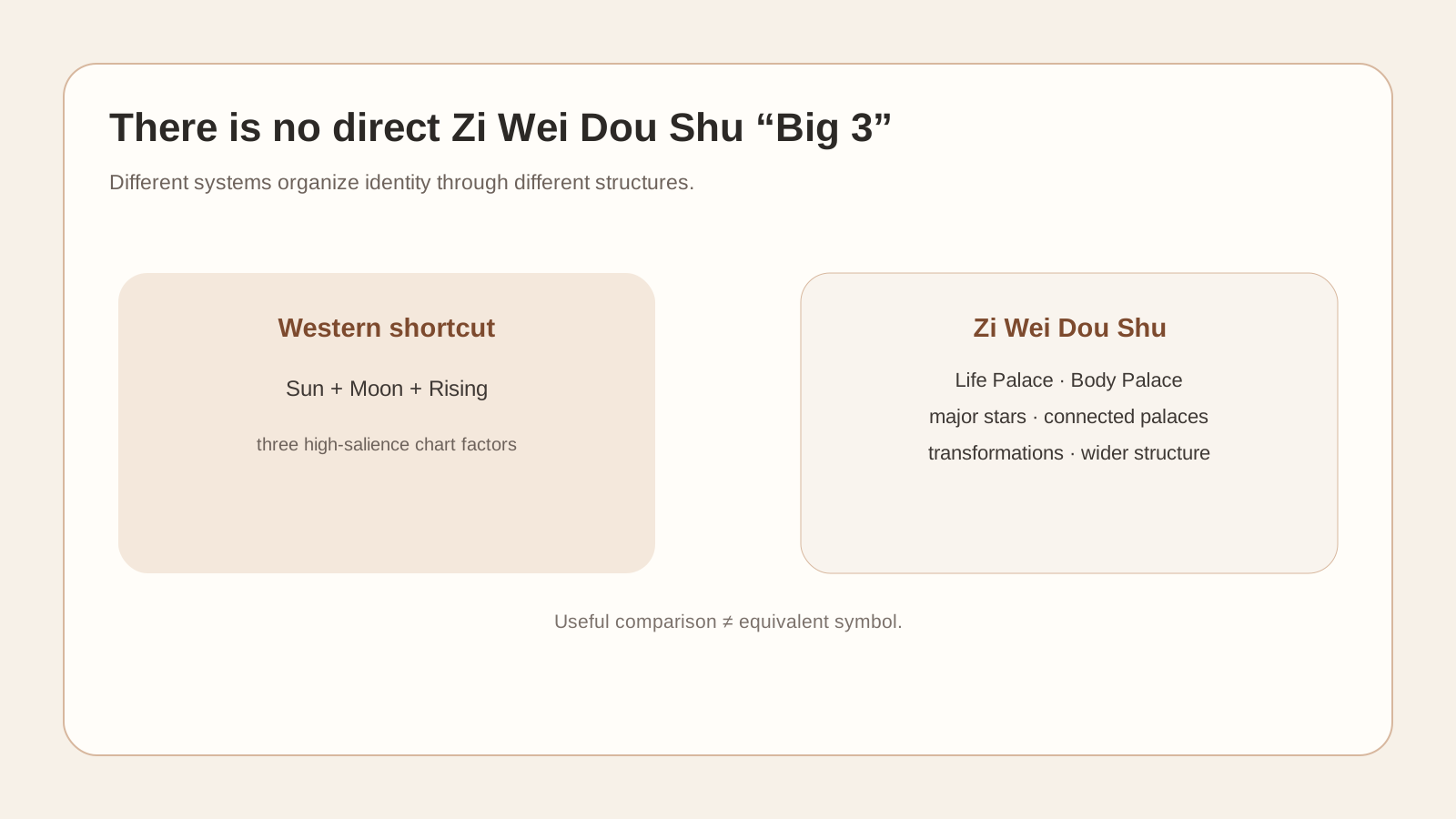
For the narrower question about the Ascendant, read Does Chinese Astrology Have a Rising Sign? For the wider calculation and interpretation differences, use Western Astrology vs Zi Wei Dou Shu.
Keep one question beside both readings
Choose an experience with a useful contrast: perhaps you value dependable routines but also enjoy starting unfamiliar projects. Read each chart within its own method, asking what the explanation actually adds. A Western answer should not merely repeat three sign descriptions; a YUVA answer should not merely list three attractive star names.
For focused examples, see Taurus and change, which separates continuity from familiarity, or Pisces creativity, which follows the difference between a private interest and a shared deliverable.
With your own YUVA Reading, an optional Ask question could be: “This passage discusses preserving stability. How does it fit with the parts of my chart about work and unfamiliar settings? I enjoy some changes and hesitate over others.” Refer to a passage actually present in your result, rather than importing the fictional example as your own.
From your Big 3 to your own YUVA chart
Your three Western sign labels are not enough to calculate YUVA. Use your original birth details: date, known local birth time, and verified birthplace, along with the form’s other calculation inputs. With an unknown time, consult the birth-time guide rather than filling in noon to produce a complete-looking result.
My Star is free without an account. Your personal Free Reading is free after sign-in and uses 0 Credits. Ask and the complete two-person Relationship Reading have separate Credit rules. The first-session guide explains how to move from the preview to one useful reading question.
Calculation notes
The fictional location was 31.22222° N, 121.45806° E, Asia/Shanghai. Western positions used 1995-03-20 at 00:00 UTC, Swiss Ephemeris 2.10.03, explicit Moshier, and the tropical zodiac; degrees are rounded within each sign. See Swiss Ephemeris documentation. YUVA returned ziwei-chart-v3 and an adjusted calculation time of 07:58. That adjustment belongs to the YUVA calculation, not the Western one.
Both tables contain calculated results from fictional inputs, not personal AI Readings or customer stories. The interpretation examples are editorial. Neither astrology nor Zi Wei Dou Shu is a scientifically validated personality test or prediction; comparing their structures does not establish that one is more accurate.